
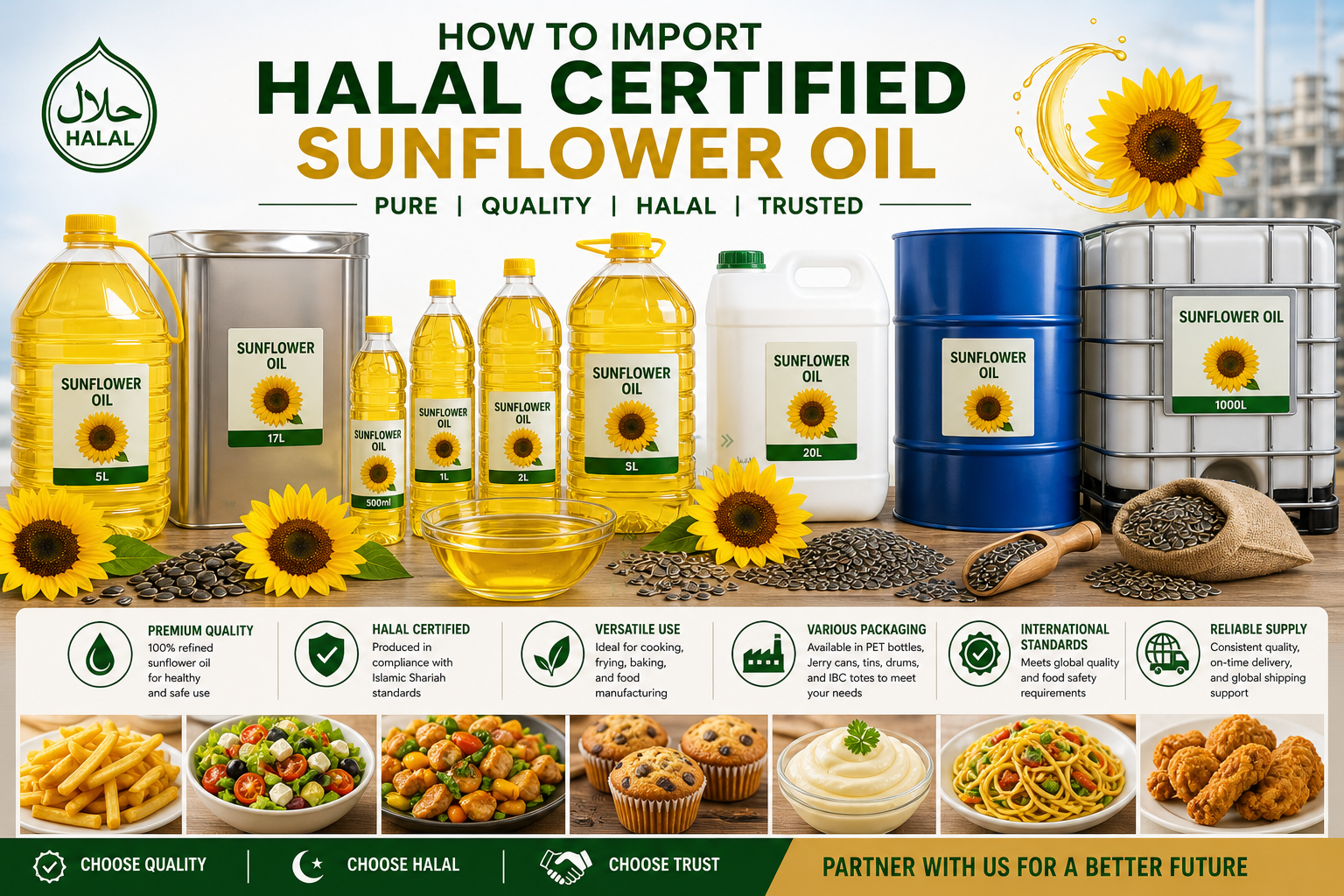
How to Import Halal Certified Sunflower Oil
Importing halal certified sunflower oil requires more than finding a supplier with competitive pricing. Buyers must confirm halal documentation, food safety compliance, product quality, packaging suitability, export readiness, and reliable logistics before placing a commercial order.
This guide is written for importers, distributors, wholesalers, food manufacturers, retailers, and private label brands that want to source halal sunflower oil for international markets. It explains what buyers should check before importing, how halal certification fits into the supply process, and how to reduce risk when working with a sunflower oil exporter.
What Is Halal Certified Sunflower Oil?
Halal certified sunflower oil is sunflower oil that has been produced, handled, stored, and documented according to halal requirements verified by a recognized halal certification body. Since sunflower oil is plant-based, buyers often assume it is automatically halal. In international trade, that assumption is not enough.
Commercial buyers usually require proof that the oil has not been exposed to non-compliant materials during production, storage, packaging, or transport. This is especially important for supermarkets, food manufacturers, importers supplying Muslim-majority markets, and companies producing halal-certified food products.
For buyers sourcing from Ukraine or Europe, Inter Oliya supports halal-focused procurement through its halal certified sunflower oil supply structure, supported by export documentation and commercial buyer assistance.
Why Halal Certification Matters for Sunflower Oil Importers
Halal certification helps buyers prove product suitability for Muslim consumers and halal-regulated food supply chains. It is also a trust signal for retailers, food factories, distributors, and importers that need clear documentation before approving a supplier.
For many markets, halal documentation can influence whether the product is accepted by wholesalers, food processors, supermarkets, or government-linked procurement channels. Buyers should also review general food safety and import requirements, because halal certification does not replace food safety compliance.
International buyers should review official food safety systems such as the European Commission General Food Law requirements and relevant local halal import rules before confirming an order.
Who Imports Halal Certified Sunflower Oil?
Halal certified sunflower oil is commonly imported by companies that need both commercial supply reliability and certification confidence. These buyers include:
- Food manufacturers producing halal-certified products
- Supermarkets and retail chains serving halal consumer markets
- Wholesale cooking oil distributors
- Importers supplying Muslim-majority regions
- Private label cooking oil brands
- Hotel, restaurant, and catering supply companies
- Industrial food processors using sunflower oil as an ingredient
For buyers planning their own branded product, halal sunflower oil can also be supplied through private label sunflower oil production with custom bottle, carton, and label options.
Step 1: Confirm the Supplier’s Halal Documentation
The first step is to confirm that the supplier can provide valid halal documentation. Buyers should request the halal certificate before final order approval and check that the certificate matches the product, company, issuing body, and validity period.
A proper supplier should be able to explain what the certificate covers. For example, buyers should confirm whether the certificate applies to refined sunflower oil, bottled sunflower oil, bulk sunflower oil, or private label packaging.
When reviewing a supplier, also compare halal certification with broader compliance documents available through pages such as certifications, halal certification, ISO standards, and HACCP certification.
Step 2: Check Food Safety and Quality Control Standards
Halal certification is important, but importers should also verify food safety and production controls. Sunflower oil for export should be supported by quality control procedures, storage discipline, packaging hygiene, and traceable documentation.
Buyers should review whether the supplier follows structured quality checks during refining, bottling, storage, and loading. This is especially important when importing oil for food manufacturing, retail distribution, or private label sale.
You can review the related process through sunflower oil quality control and sunflower oil refining process. International buyers can also consult official EU import control information from the European Commission imported products guidance.
Step 3: Choose the Right Sunflower Oil Type
Before importing, buyers must confirm which sunflower oil type fits their market. Not every buyer needs the same product format.
| Oil Type | Best For | Buyer Intent |
|---|---|---|
| Refined Sunflower Oil | Retail, food service, food manufacturing | Food-grade commercial supply |
| Bottled Sunflower Oil | Supermarkets and distributors | Ready-to-sell cooking oil |
| Private Label Sunflower Oil | Brands and retail chains | Custom branded halal cooking oil |
| Bulk Sunflower Oil | Factories, processors, wholesalers | Large-volume procurement |
Most halal buyers choose refined sunflower oil or bottled sunflower oil because these formats are suitable for direct food use, retail, and food production.
Step 4: Confirm Packaging Requirements
Packaging plays a major role in halal sunflower oil import. Buyers should confirm whether they need retail bottles, cartons, pallets, private label packaging, or bulk loading. Packaging must protect the oil, support shelf stability, and meet commercial handling expectations in the destination market.
Common packaging options include:
- 1L bottles for retail and supermarket distribution
- 2L and 5L bottles for household and food service buyers
- 10L and 20L containers for catering and commercial kitchens
- Carton-packed bottled oil for retail distribution
- Palletized shipments for wholesale buyers
- Bulk loading for industrial food manufacturers
For more detail, buyers can review packaging solutions, packaging types, and everything buyers should know about sunflower oil packaging.
Step 5: Review Import Documentation
Import documentation must be handled carefully. Missing or inconsistent documents can delay customs clearance, create extra costs, or cause buyer-side compliance problems.
Typical documents may include:
- Commercial invoice
- Packing list
- Certificate of origin
- Bill of lading or transport document
- Halal certificate
- Quality certificate or analysis report where required
- Food safety or certification documents requested by the buyer
Requirements vary by destination market, so buyers should confirm local import rules before shipment. For structured export guidance, review export compliance and export documentation required for sunflower oil.
Step 6: Understand Shipping Terms Before Ordering
Shipping terms affect cost, responsibility, risk, and delivery control. Before importing halal sunflower oil, buyers should understand whether the quotation is based on FOB, CIF, DAP, DDP, or another commercial term.
For international buyers, this is important because the difference between product price and landed cost can be significant. Freight, insurance, customs handling, local taxes, and inland delivery must be considered before confirming an order.
Buyers can review delivery terms and understanding CIF, FOB, and DAP shipping terms. For official trade terminology, the ICC Incoterms rules are the most recognized international reference.
Step 7: Plan Logistics and Delivery Time
Halal sunflower oil shipments can move by road, sea freight, container transport, or mixed logistics depending on the destination and order size. European buyers often require road freight or containerized delivery, while international buyers may require sea freight and port coordination.
Delivery time depends on origin, destination, packaging format, order quantity, production schedule, port availability, and customs processing. Buyers should confirm realistic timelines before committing to retail campaigns, food manufacturing schedules, or distributor contracts.
Useful related guides include shipping methods, export logistics, international logistics for sunflower oil supply, and how long sunflower oil shipping takes.
Step 8: Verify the Supplier Before Payment
Supplier verification is essential in international edible oil trade. Buyers should confirm company identity, product availability, certification documents, communication consistency, and export capability before payment.
A reliable supplier should provide clear answers about product type, order quantity, packaging, loading method, documentation, delivery terms, and quotation validity. Buyers should be cautious of unclear pricing, missing certificates, unrealistic delivery claims, or suppliers that avoid documentation checks.
Before confirming an order, review how to verify a sunflower oil exporter and how to choose a reliable sunflower oil supplier.
Common Mistakes When Importing Halal Sunflower Oil
Many import problems happen because buyers focus only on price. In halal food supply, documentation, certification, packaging, and logistics can be just as important as the product cost.
- Accepting halal claims without checking the certificate
- Failing to confirm whether certification covers the exact product
- Ignoring destination-country import requirements
- Not checking packaging suitability before ordering
- Comparing FOB and delivered prices incorrectly
- Not verifying supplier export capability
- Leaving documentation review until after shipment
These mistakes can be avoided by working with a supplier that understands both halal certification and international sunflower oil export operations.
Why Importers Work with Inter Oliya
Inter Oliya supplies sunflower oil products for commercial buyers, importers, distributors, food manufacturers, and private label brands. The company supports international buyers with product selection, packaging options, certification guidance, export documentation, and logistics coordination.
Buyers interested in halal-certified supply can explore halal certified sunflower oil, bulk sunflower oil supply, private label sunflower oil, and international export.
For a formal offer, buyers can submit their product type, quantity, destination, packaging preference, and company details through the request quote page.
Final Checklist Before Importing Halal Certified Sunflower Oil
- Confirm the supplier’s halal certificate
- Check ISO, HACCP, and food safety documentation where required
- Confirm product type and packaging format
- Review destination-country import requirements
- Clarify shipping terms and landed cost
- Request export documentation before shipment
- Verify supplier identity and export capability
- Confirm lead time and delivery route
Conclusion
Importing halal certified sunflower oil requires careful supplier selection, documentation review, packaging planning, and logistics coordination. The strongest buyers do not rely on price alone; they evaluate certification, food safety, export capability, and long-term supply reliability.
For importers, distributors, food manufacturers, and private label brands, halal certified sunflower oil can be a strong product category when sourced from an experienced export supplier with clear documentation and commercial support.
Request Halal Sunflower Oil Supply Information
If your company needs halal certified sunflower oil for import, distribution, food manufacturing, or private label production, send your quantity, destination country, packaging requirement, and company details.
Frequently Asked Questions
Is sunflower oil naturally halal?
Sunflower oil is plant-based, but commercial buyers often require halal certification to confirm that production, handling, storage, and packaging meet halal requirements.
What documents are needed to import halal sunflower oil?
Common documents include a commercial invoice, packing list, certificate of origin, transport document, halal certificate, and any food safety or quality documents required by the destination market.
Can halal sunflower oil be supplied as private label?
Yes. Halal sunflower oil can be supplied through private label production with custom bottles, labels, cartons, and export-ready packaging depending on buyer requirements.
What packaging is best for halal sunflower oil import?
Retail buyers usually choose bottled packaging such as 1L, 2L, or 5L bottles, while food manufacturers and wholesalers may choose larger containers, pallets, or bulk formats.
How do I verify a halal sunflower oil supplier?
Check the company identity, halal certificate validity, product documentation, export experience, packaging options, and ability to provide clear commercial and logistics information.
Does halal certification replace food safety certification?
No. Halal certification confirms halal suitability, while food safety systems such as ISO, HACCP, and import controls address hygiene, traceability, and product safety requirements.