
ISO 22000, Food-Safety Systems & Buyer Verification
ISO 22000 for Sunflower Oil Production, Handling & Supplier Approval
Understand how ISO 22000 applies to sunflower-oil producers, refineries, packers, storage operators and related food-chain organizations. This buyer guide explains the current standard, management-system scope, HACCP integration, certification evidence, audit records and the checks needed before accepting an ISO claim.
- ISO 22000:2018Current published edition on 5 August 2026
- HACCP IntegratedHazard control within a management system
- Facility SpecificHolder, site and scope must match
- Third-Party CertificationISO does not issue certificates
This page does not claim that Inter Oliya holds a current ISO 22000 certificate. Applicable evidence must match the actual organization, facility and product.
Check the Exact Edition
ISO 22000:2018 is current; ISO 22000:2005 is withdrawn.
Verify the Holder and Site
A certificate applies only to its named organization, locations and scope.
Review Records, Not Only a PDF
Audits, hazards, monitoring, corrections and verification show system operation.
Check Certification Competence
Confirm the certification body and accreditation status where required.
Direct Buyer Answer
What is ISO 22000 in sunflower-oil production?
ISO 22000 is an international standard specifying requirements for a food-safety management system. It can apply to sunflower-oil producers, refineries, filling and packing operations, storage and transport organizations, suppliers and other food-chain participants.
The standard combines management-system requirements with prerequisite programmes, interactive communication and HACCP principles. Its purpose is not simply to create documents, but to help an organization identify food-safety hazards, establish controls, operate the system, verify performance and improve it.
Certification is optional. An organization can implement ISO 22000 without being certified, while a certificate is third-party assurance that the named system was assessed against the stated requirements.
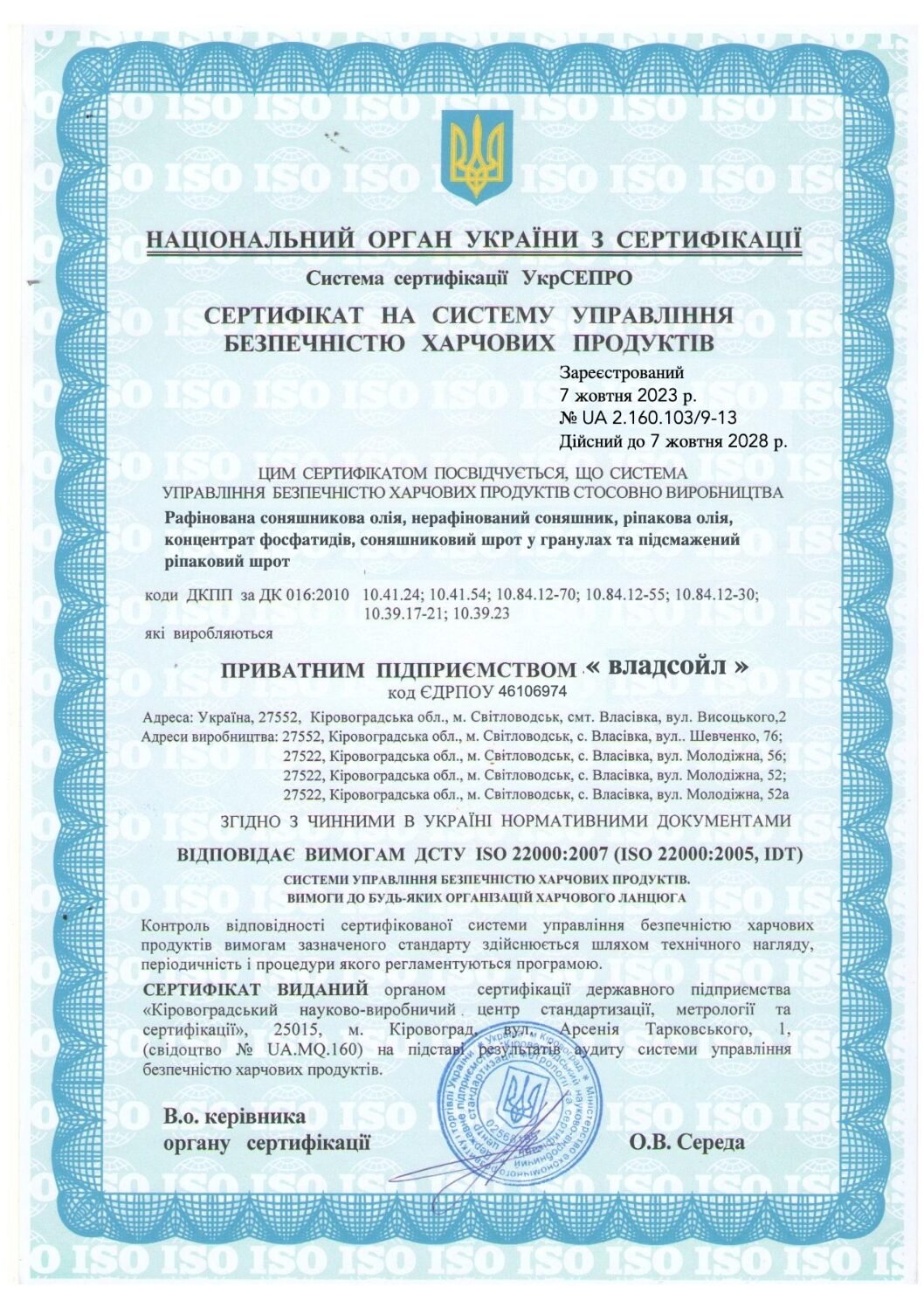
A generic ISO image or unrelated certificate cannot prove the system at a different facility.
Standard & Website Document Status
Current ISO edition and Inter Oliya’s public document position
Buyers should distinguish the current international standard from any certificate previously displayed on a supplier website.
ISO 22000 status reviewed 5 August 2026
- Current publication
- ISO 22000:2018, Edition 2
- Publication status
- Published and current
- Last confirmation
- Reviewed and confirmed in 2023
- Amendment
- ISO 22000:2018/Amd 1:2024 published
- Next edition
- ISO/DIS 22000 under development
- Previous edition
- ISO 22000:2005 withdrawn
- Certification issuer
- External certification body—not ISO
ISO 22000 Food-Safety Management System
The core system areas buyers should understand
The facility’s documented system should be translated into controlled, verifiable practice.
Context & Scope
Define the organization, facilities, products, processes, interested parties and system boundaries.
Leadership
Establish policy, responsibilities, resources, accountability and food-safety culture.
Risk-Based Planning
Address management-system risks and opportunities separately from operational food-safety hazards.
Support
Control competence, training, communication, infrastructure, work environment and documented information.
Prerequisite Programmes
Maintain hygienic conditions supporting safe production, handling, storage and transport.
Hazard Control
Use hazard analysis to determine control measures, OPRPs, CCPs, critical limits and monitoring.
Performance Evaluation
Use monitoring, measurement, internal audits and management review to assess effectiveness.
Improvement
Correct nonconformities, identify causes, update the system and continually improve performance.
Application Across Sunflower-Oil Operations
How ISO 22000 connects to production, packing, storage and export preparation
The certificate scope must identify which operations and sites are included.
Supplier & Raw-Material Control
Approved suppliers, specifications, intake checks, sampling, contaminants and transport history.
Refining & Process Control
Defined parameters, processing aids, equipment, monitoring, deviations and product disposition.
Water, Air, Steam & Chemicals
Assess utility quality, chemical use, maintenance materials and potential contamination routes.
Filling, Closure & Coding
Packaging approval, line clearance, fill control, coding, label accuracy and pack integrity.
Tanks, Warehouse & Segregation
Control identity, cleanliness, stock status, environmental conditions, pests and traceability.
Loading & Dispatch
Review transport-unit suitability, previous cargo, loading checks, seals and document reconciliation.
Traceability, Withdrawal & Recall
Connect inputs, production, tanks, packs and customers and test the response process.
Testing, Audit & Review
Use laboratory results, record review, observations, internal audit and management review.
New Product & Process Control
Reassess hazards and system controls when ingredients, equipment, suppliers, facilities or packs change.
ISO 22000, HACCP, COA & Certification
Each document answers a different procurement question
ISO 22000 Standard
Defines food-safety management-system requirements for organizations in the food chain.
HACCP Plan & Records
Show how significant hazards are identified, controlled, monitored and verified in the actual process.
Certificate of Analysis
Reports technical test results for a named product or batch; it does not certify the management system.
Third-Party Certificate
Provides assurance for the named holder, site, standard, scope and valid certification period.
Certificate Verification
Twelve checks before accepting an ISO 22000 claim
Legal Certificate Holder
Match the legal name and registration code to the operating organization.
Facility Address
Confirm all production, packing, storage or loading sites relevant to the order.
Standard Edition
Identify ISO 22000:2018 and any applicable amendment rather than relying on a withdrawn edition.
Certified Scope
Match products, processes and activities to the quoted sunflower-oil supply.
Certification Body
Identify the independent body that audited and issued the certificate.
Accreditation Status
Confirm the certification body’s relevant accreditation where the buyer requires it.
Certificate Number
Use the exact number to verify and control the document in the buyer file.
Issue & Expiry Dates
Check the valid period, surveillance cycle, renewal and current status.
Suspension or Withdrawal
Confirm that the certificate has not been suspended, withdrawn or restricted.
Product & Batch Linkage
Connect the certified system to the actual product, specification, COA and batch.
Audit Evidence
Request current audit status, major findings and corrective-action closure where appropriate.
Destination Acceptance
Confirm retailer, importer or regulatory requirements for certification and accreditation.
Practical Verification Steps
How to verify an ISO 22000 certificate in six steps
Move beyond a simple PDF review. Use this structured approach to confirm the certificate’s validity and applicability to your order.
Obtain the original PDF
Request the full, unredacted certificate from the supplier, not a screenshot or summary.
Check the holder and registration
Compare the legal name and registration number (e.g., USREOU) with the contracting entity.
Map facilities to scope
Ensure the address(es) listed match the production, packing or loading site for your order.
Confirm the standard edition
ISO 22000:2018 is current; older editions are withdrawn and not acceptable.
Verify the certification body
Check that the issuer is an accredited certification body acceptable to your market.
Contact the issuer for status
Many certification bodies allow online verification; otherwise, call or email to confirm active status.
Myths & Facts
Common misconceptions about ISO 22000 certification
Understanding these distinctions helps buyers avoid costly errors in supplier evaluation.
| Myth | Fact |
|---|---|
| ISO certifies companies. | ISO develops standards but does not issue certificates. Certification is done by independent certification bodies. |
| A certificate is a company‑wide proof. | Certification applies to the named organization, specific facilities and defined scope only. |
| All ISO 22000 certificates are equal. | Accreditation, certification body competence, edition and surveillance differ significantly. |
| Implementation and certification are the same. | An organization can implement ISO 22000 without certification; a certificate requires a third‑party audit. |
| An old certificate is still valid. | Expired, suspended or withdrawn certificates offer no assurance. Always check current status. |
| A certificate guarantees product quality. | It assures a management system; product quality and safety also require specification, COA and batch testing. |
Beyond the Certificate
Evidence that the food-safety management system is operating
A current certificate can support approval, but implementation records show whether controls are working in the facility connected to the order.
| System area | Evidence to review | Buyer question |
|---|---|---|
| Scope and organization | FSMS scope, site list, organization chart and responsibilities | Does the system cover the actual product and operating facility? |
| Prerequisite programmes | Cleaning, hygiene, pests, maintenance, chemicals, storage and transport controls | Are the basic operating conditions controlled? |
| Hazard analysis | Process flow, hazards, significance method, controls, OPRPs and CCPs | Is the hazard study specific to the actual process? |
| Monitoring | Recent OPRP/CCP and operational-control records | Are checks completed at the defined frequency? |
| Nonconformity | Deviations, affected-product control, root cause and corrective action | How are failures contained and prevented from recurring? |
| Verification | Testing, observations, record review, calibration and validation | Does the organization verify the system’s effectiveness? |
| Internal audit | Audit programme, findings, corrections and closure | Are weaknesses identified and followed through? |
| Management review | Review inputs, decisions, resources and improvement actions | Is leadership evaluating performance and change? |
| Traceability and recall | Lot linkage, mass balance, mock recall and corrective action | Can affected product be identified and controlled quickly? |
| Competence | Training, qualification, evaluation and refresher records | Are personnel competent for their food-safety responsibilities? |
Supplier Approval Workflow
From ISO requirement to order-specific verification
Define Buyer Requirement
State the required standard, accreditation, product, facility and evidence.
Identify Operating Facility
Confirm the producer, refinery, packer, warehouse or loading operation.
Review Certificate
Check holder, site, edition, scope, issuer, accreditation, number and dates.
Verify Current Status
Confirm renewal, surveillance, suspension, withdrawal and database or issuer status.
Sample Implementation
Review hazard, monitoring, audit, traceability, recall and corrective-action records.
Connect Product & Batch
Match the specification, COA, facility, production or packing and shipment.
Write Contract Requirements
State certificate, scope, status, audit and document obligations.
Reconfirm Before Dispatch
Verify that the certificate and product file remain applicable and current.
Clear Topical Ownership
Choose the page matching your food-safety or compliance question
ISO 22000 Standards
Food-safety management systems, current edition, certificate verification and implementation evidence.
Review ISO statusHACCP for Sunflower Oil
Seven principles, 12 steps, hazard analysis, CCPs and facility records.
Review HACCP guidanceCertifications Hub
Current website position on ISO, HACCP, Halal and other compliance documents.
Review certificationsQuality Control
Specifications, sampling, testing, inspection, COA, traceability and release.
Review quality controlManufacturing
Supplier, process, facility and production-capability assessment.
Review manufacturingExport Compliance
Customs, origin, destination and shipment-document requirements.
Review export complianceLegal Supplier vs Certified Facility
Verify Inter Oliya separately from the ISO certificate holder
Transparent commercial and certification roles
Inter Oliya is a registered Ukraine-based supply and trade company. The producer, refinery, packing facility, warehouse or loading operation proposed in a quotation may be a separate legal entity.
This page does not claim that Inter Oliya currently holds ISO 22000 certification. Buyers should review the certificate and implementation evidence for the actual facility connected to the order.
The registered office is supplied for legal verification and is not presented as a refinery, factory, warehouse or certification scope location.
ISO 22000 Sunflower Oil FAQ
Questions from importers, manufacturers and retail buyers
The current standard, certificate, scope and facility records govern the actual supplier approval.
What is ISO 22000 for sunflower oil production?
ISO 22000 specifies food-safety management-system requirements for organizations in the food chain. It combines system management, communication, prerequisite programmes and HACCP principles.
Which ISO 22000 edition is current?
As of 5 August 2026, ISO 22000:2018 remains the current published edition. ISO 22000:2005 is withdrawn, and ISO/DIS 22000 is under development.
Is Inter Oliya ISO 22000 certified?
This page does not claim that Inter Oliya holds a current ISO 22000 certificate. Applicable evidence should be requested for the actual producer, refinery, packer, warehouse or loading facility.
Why was the old ISO PDF removed from the page?
The previously linked PDF identifies another legal entity and registration code and references a standard based on the withdrawn ISO 22000:2005 edition. It should not be presented as Inter Oliya certification.
Does ISO certify companies?
No. ISO develops international standards but does not audit organizations or issue certificates. Certification is performed by external certification bodies.
Is ISO 22000 certification mandatory?
No. Organizations can implement ISO 22000 without certification. Buyers may nevertheless require third-party certification contractually.
How is ISO 22000 related to HACCP?
ISO 22000 integrates HACCP principles and application steps within a broader food-safety management system that also covers leadership, communication, resources, audits and improvement.
Does an ISO certificate replace a product COA?
No. The certificate applies to the management system and scope. A COA reports test results for an identified product or batch.
What should a buyer verify on an ISO 22000 certificate?
Verify the holder, facilities, standard edition, scope, certification body, accreditation, certificate number, issue and expiry dates and current status.
What implementation records should buyers review?
Review prerequisite programmes, hazard analysis, monitoring, deviations, corrective actions, verification, audits, management review, training, traceability and recall testing.
Facility-Specific Food-Safety Verification
Request the ISO 22000 and product evidence applicable to your order
Submit the product, quantity, packaging, destination and certification requirements so the proposed facility, certificate scope and product file can be reviewed.