
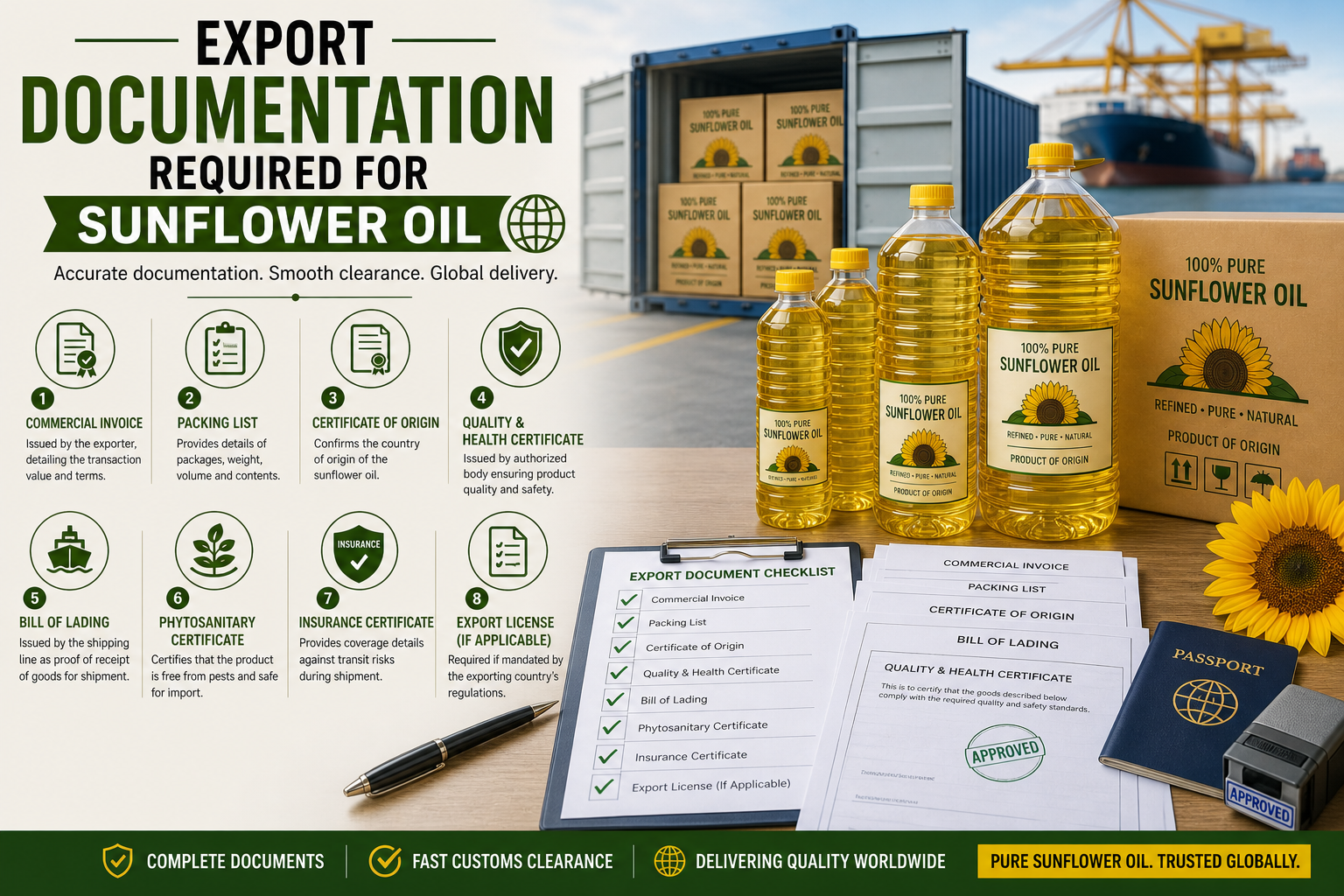
Export Documentation Required for Sunflower Oil
Export documentation for sunflower oil is one of the most important parts of international trade. Even when product quality, price, packaging, and shipping terms are agreed, a shipment can still be delayed if the required documents are incomplete, inaccurate, or inconsistent.
For importers, distributors, food manufacturers, and wholesale buyers, export documents confirm what is being shipped, who is selling, who is buying, where the product is going, how it is packed, and whether it meets commercial and regulatory requirements.
At Inter Oliya’s export compliance process, documentation is treated as part of the full supply chain, alongside product quality, packaging, storage, and logistics.
Why Export Documentation Matters in Sunflower Oil Trade
Sunflower oil is a food-grade commodity traded across international borders. Because of this, buyers and suppliers must prepare documents for customs clearance, transport, payment, insurance, origin verification, and food safety review.
According to international trade guidelines published by the European Commission Trade Portal, proper documentation is essential for customs clearance and compliance with import regulations.
Additionally, global food standards such as those from the Codex Alimentarius Commission define quality and safety requirements for edible oils, including sunflower oil.
Main Export Documents Required for Sunflower Oil
1. Commercial Invoice
The commercial invoice is the primary financial document in any export transaction. It defines the product, value, and agreed trade terms.
It must clearly specify whether the shipment contains refined sunflower oil, crude sunflower oil, or packaged retail products.
2. Packing List
The packing list details how the goods are packed and shipped. It supports customs inspections and logistics handling.
This is especially important for shipments using different packaging formats such as flexitanks, drums, or bottled products.
3. Bill of Lading or Sea Waybill
The bill of lading is issued by the carrier and confirms that the goods have been loaded for shipment. It is used for transport, customs clearance, and sometimes payment processing.
Major logistics providers such as Maersk outline the bill of lading as one of the core documents required for international cargo movement.
For shipping options, buyers can review sunflower oil shipping methods.
4. Certificate of Origin
This document confirms the country where the sunflower oil was produced or processed. It may be required for customs clearance or preferential duty treatment.
Trade agreements and origin verification systems are explained by organizations such as the World Trade Organization (WTO).
5. Customs Declaration
The customs declaration includes product classification, value, origin, and destination details. It is used by customs authorities to assess duties and verify compliance.
Accurate classification is critical, as incorrect HS codes can result in delays or penalties.
6. Certificate of Analysis (COA)
The certificate of analysis provides laboratory test results confirming oil quality.
For buyers sourcing bulk sunflower oil, this document verifies parameters such as acidity, peroxide value, moisture, and impurities.
7. Food Safety and Health Certificates
Some markets require additional food safety documentation. These may be based on international standards such as ISO 22000, which defines food safety management systems.
These certificates help ensure that sunflower oil meets regulatory requirements in the destination country.
8. Insurance Certificate
An insurance certificate confirms that the shipment is covered during transport. This is particularly important for CIF shipments, where the seller arranges insurance.
9. Inspection Certificate
Some buyers require third-party inspection to verify product quality and quantity before shipment. This adds an extra layer of trust and verification.
10. Halal Certificate (If Required)
For certain markets, a halal certificate may be required. Buyers can review halal certified sunflower oil and halal certification details.
How Incoterms Affect Export Documentation
Incoterms define the responsibilities of buyers and sellers in international trade. They determine who arranges transport, insurance, and documentation.
The official definitions are published by the International Chamber of Commerce (ICC), which provides globally recognized trade rules.
Buyers can also review delivery terms to understand how these rules apply in sunflower oil shipments.
Common Documentation Mistakes That Cause Delays
- Incorrect product descriptions
- Mismatched weights across documents
- Wrong HS code classification
- Missing certificates
- Inconsistent consignee details
- Incorrect Incoterms
Consistency across all documents is essential for smooth customs clearance.
Conclusion
Export documentation is a critical part of sunflower oil trade. Proper documentation ensures smooth customs clearance, reduces delays, and builds trust between buyers and suppliers.
Understanding these requirements helps importers make informed decisions and ensures successful international transactions.
If you are sourcing sunflower oil for export, you can explore export logistics or submit a request through the request quote page.