
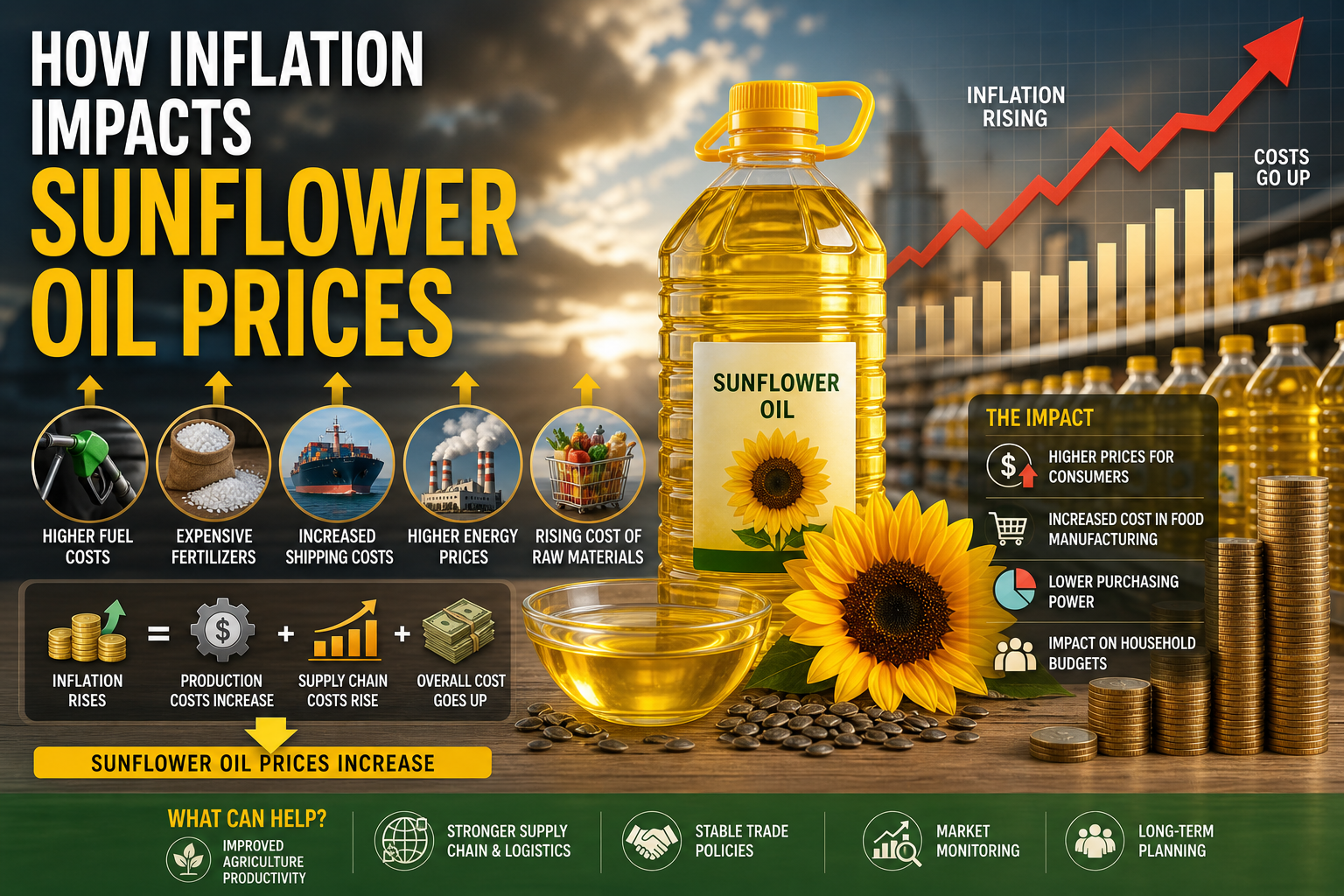
How Inflation Impacts Sunflower Oil Prices
Inflation affects sunflower oil prices through several connected cost layers: farming inputs, energy, refining, packaging, transport, storage, currency exchange, and final distribution. For importers, wholesalers, food manufacturers, and private label brands, understanding these cost drivers is essential before negotiating supply contracts or comparing supplier quotations.
Sunflower oil is part of the wider edible oil and agricultural commodity market. This means its price can move not only because of sunflower seed supply, but also because of changes in fuel prices, fertilizer costs, shipping rates, packaging materials, and demand for alternative oils such as palm, soybean, and rapeseed oil.
For buyers sourcing from an international bulk sunflower oil supplier, inflation should not be viewed as one single price increase. It is usually the result of multiple pressures moving through the supply chain at the same time.
Why Inflation Matters in Sunflower Oil Procurement
Inflation matters because sunflower oil is not priced only by the finished product. The final price reflects a chain of costs from agricultural production to export delivery. When inflation increases across energy, labor, packaging, freight, and finance, those increases can influence the cost of refined oil, bottled oil, private label supply, and bulk shipments.
For B2B buyers, this affects:
- Bulk purchase prices per metric ton
- Retail bottle and carton packaging costs
- Private label production budgets
- Export freight and delivery charges
- Supplier quotation validity periods
- Long-term contract planning
Market data also shows how food and commodity inflation can move quickly. The FAO Food Price Index rose in March 2026, with price increases across commodity groups including vegetable oils, partly reflecting higher energy prices and market fundamentals. FAO’s Food Price Index is one of the most useful global references for tracking food commodity movements.
Energy Costs Are One of the Biggest Price Drivers
Energy prices affect sunflower oil pricing at almost every stage of the supply chain. Fuel is needed for agricultural machinery, seed transport, refinery operations, packaging production, warehouse handling, and international freight.
When energy prices rise, buyers may see higher costs in:
- Farm production and harvesting
- Seed crushing and oil refining
- Factory energy use
- Road freight and port transport
- Sea freight and container movement
- Plastic bottle and packaging production
The World Bank reported that overall commodity prices were forecast to rise in 2026, driven strongly by energy and fertilizer costs. This matters because higher energy prices often move into agricultural and food supply chains through transport, production, and input costs. World Bank commodity market data is a useful reference for buyers monitoring global cost pressure.
Fertilizer and Farming Input Costs Affect Seed Supply
Sunflower oil begins with sunflower seed production. When fertilizer, fuel, labor, and agricultural inputs become more expensive, farmers may face higher production costs. Over time, this can influence planting decisions, crop profitability, and seed availability.
If seed production becomes more expensive, the cost pressure can move into:
- Crude sunflower oil prices
- Refined sunflower oil prices
- Bulk sunflower oil contracts
- Food manufacturing procurement budgets
This is especially important for buyers comparing crude sunflower oil with refined sunflower oil. Crude oil is more directly connected to raw agricultural supply, while refined oil includes additional processing, refining, packaging, and handling costs.
Freight Inflation Changes the Landed Cost
Many buyers focus on product price but underestimate freight inflation. In international sunflower oil trade, the real cost is often the landed cost, not only the factory price. Landed cost includes product price, transport, documentation, insurance where applicable, customs clearance, port costs, inland delivery, and local handling.
Freight inflation can affect:
- Container shipping rates
- Road freight prices
- Port handling costs
- Fuel surcharges
- Warehouse and storage fees
- Last-mile delivery charges
Before confirming an order, buyers should review shipping methods, export logistics, and delivery terms. Understanding whether a quote is FOB, CIF, DAP, or DDP is critical when comparing suppliers. The ICC Incoterms rules remain the key international reference for trade term definitions.
Packaging Inflation Affects Bottled and Private Label Oil
Inflation has a strong effect on packaging costs, especially for bottled sunflower oil and private label production. Bottle resin, caps, labels, cartons, pallets, stretch film, and printing materials all add cost to the finished product.
This is why the price of bottled sunflower oil may change differently from bulk oil. A bulk shipment may be more exposed to freight and raw oil prices, while bottled and private label products are also exposed to packaging material costs.
For private label buyers, inflation can affect:
- Bottle cost
- Label printing
- Carton production
- Palletization
- Minimum order economics
- Custom packaging lead times
Buyers planning branded products should review private label sunflower oil, packaging solutions, and sunflower oil packaging guidance before finalizing their cost structure.
Currency Exchange Rates Can Change Import Costs
Currency movement is another important inflation-related factor. International edible oil trade often involves euros, US dollars, or local buyer currencies. If a buyer’s local currency weakens against the invoice currency, the product becomes more expensive even if the supplier’s base price has not changed.
This matters for buyers in Europe, Africa, the Middle East, and other import markets where currency volatility can affect purchasing power. In many cases, suppliers keep quotation validity short because commodity and currency conditions can change quickly.
For importers, this means it is important to confirm:
- Quotation currency
- Validity period
- Payment terms
- Delivery terms
- Whether freight is included
Inflation Can Increase Demand for Cost-Efficient Oil Formats
When food inflation rises, buyers often shift toward more cost-efficient purchasing formats. Food manufacturers may choose bulk oil, distributors may prioritize larger bottle sizes, and retailers may increase private label product ranges to offer better consumer value.
This is one reason private label cooking oil can become more attractive during inflationary periods. Retailers and distributors can control branding, packaging, and pricing more directly compared with relying only on established consumer brands.
Buyers interested in building a branded cooking oil product can explore private label sunflower oil guide and the growth of private label cooking oil brands.
How Inflation Affects Different Buyer Types
Inflation does not affect every buyer in the same way. The impact depends on volume, packaging format, destination, and purchasing model.
| Buyer Type | Main Inflation Pressure | Best Response |
|---|---|---|
| Bulk Importers | Raw oil price, freight, currency | Compare landed cost and delivery terms |
| Food Manufacturers | Ingredient cost and supply continuity | Secure reliable bulk supply planning |
| Private Label Brands | Packaging, printing, MOQ, freight | Optimize bottle size and carton format |
| Retail Distributors | Consumer price sensitivity | Offer competitive bottle sizes and private label options |
| Wholesalers | Stock turnover and delivery cost | Plan shipments based on demand and warehouse capacity |
How Buyers Can Reduce Inflation Risk
Although buyers cannot control global inflation, they can reduce procurement risk by planning carefully and working with reliable suppliers. The goal is not always to find the cheapest supplier, but to secure the best balance between price, documentation, quality, and delivery reliability.
Practical steps include:
- Request quotes with clear delivery terms
- Compare landed cost, not only product price
- Confirm packaging and pallet details before ordering
- Work with suppliers that provide export documentation
- Monitor commodity and freight market changes
- Use larger planned orders when storage capacity allows
- Avoid last-minute procurement during volatile periods
Buyers can also review how to buy sunflower oil in bulk for Europe and bulk sunflower oil buying guide for procurement planning.
Why Supplier Transparency Matters During Inflation
During inflationary periods, clear communication between buyer and supplier becomes more important. Buyers need to understand what is included in the price, what may change, and how long a quotation remains valid.
A serious supplier should be able to explain:
- Product type and origin
- Packaging format
- MOQ and order structure
- Delivery term
- Documentation support
- Estimated logistics timeline
Inter Oliya supports commercial buyers with supply information for bulk sunflower oil, refined sunflower oil, private label sunflower oil, and international export.
Conclusion
Inflation impacts sunflower oil prices through energy, farming inputs, freight, packaging, currency, and wider edible oil market conditions. For importers and B2B buyers, the key is to understand the full cost structure rather than comparing supplier prices superficially.
Buyers who plan ahead, verify supplier capability, compare delivery terms correctly, and monitor market conditions are better positioned to manage cost changes and maintain reliable sunflower oil supply.
Request Current Sunflower Oil Pricing
If your company is comparing sunflower oil pricing for bulk supply, food manufacturing, bottled oil, or private label production, send your required quantity, packaging format, destination, and delivery terms.
Frequently Asked Questions
How does inflation affect sunflower oil prices?
Inflation affects sunflower oil prices by increasing farming input costs, energy costs, refining expenses, packaging prices, freight rates, storage costs, and currency-related import costs.
Why do sunflower oil prices change so often?
Prices can change because sunflower oil is linked to agricultural supply, energy costs, freight markets, currency exchange rates, demand for vegetable oils, and global food commodity trends.
Does freight inflation affect sunflower oil imports?
Yes. Freight inflation affects container shipping, road transport, port handling, fuel surcharges, and inland delivery, which all influence the final landed cost for importers.
Is bulk sunflower oil cheaper during inflation?
Bulk sunflower oil may offer better cost efficiency for large buyers because it reduces some packaging costs, but final savings depend on freight, delivery terms, destination, and order volume.
How can buyers reduce sunflower oil procurement costs?
Buyers can reduce risk by comparing landed cost, planning orders early, choosing efficient packaging, confirming delivery terms, working with reliable suppliers, and avoiding last-minute procurement during volatile market periods.
Do packaging costs affect private label sunflower oil prices?
Yes. Private label sunflower oil prices are affected by bottle cost, label printing, cartons, pallets, packaging materials, production runs, and transport costs.