
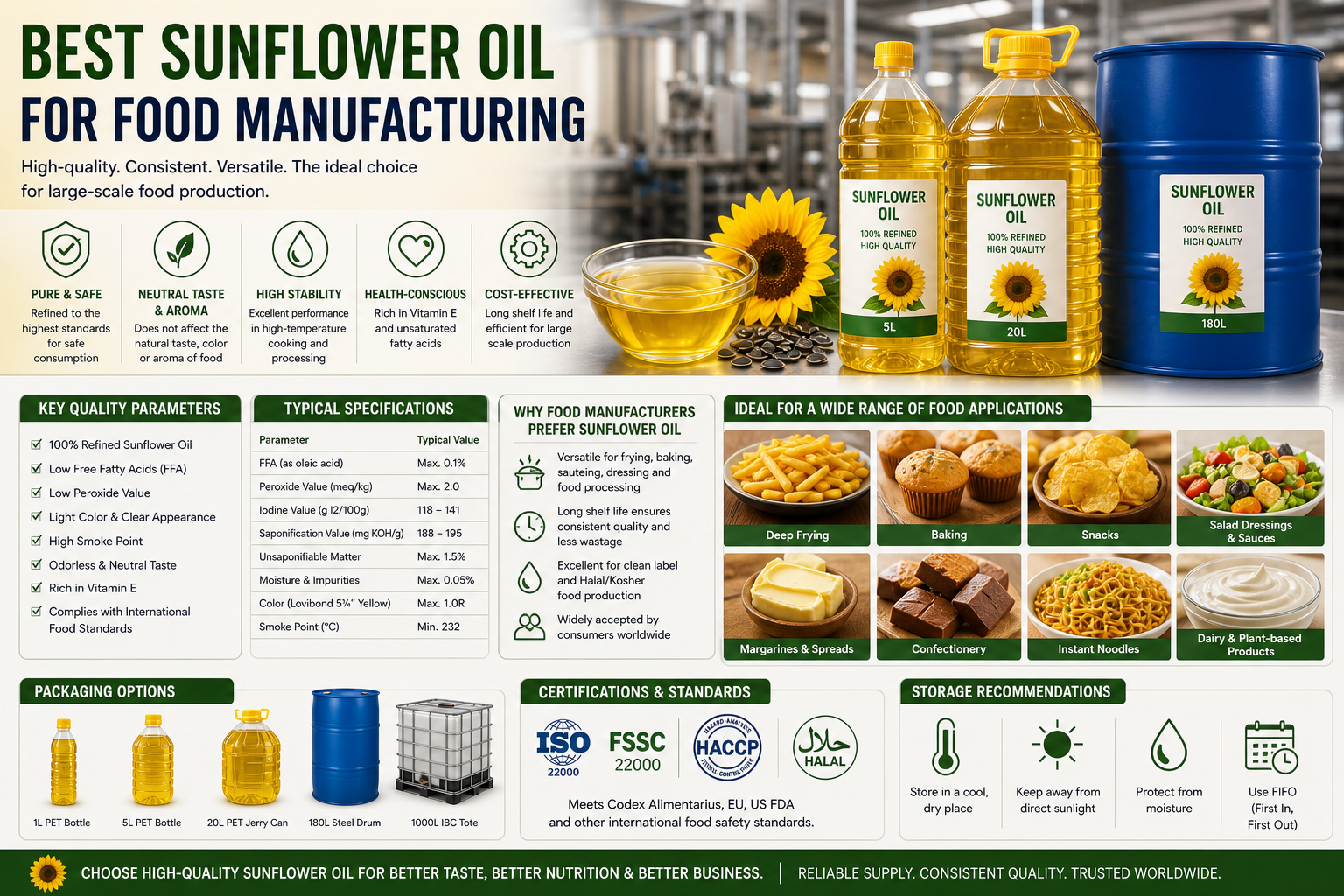
Commercial Edible Oil Buyer Guide
Choosing Sunflower Oil for Food Manufacturing
The best sunflower oil for food manufacturing depends on the product being produced, the operating temperature, the expected storage period, the desired flavour profile and the economics of the production line. A bakery, snack factory, sauce producer and continuous frying operation may all use sunflower oil, but they will not necessarily require the same grade.
Refined sunflower oil is a practical general-purpose option for many commercial applications because it has a neutral flavour and can be supplied with consistent specifications. High-oleic sunflower oil is often selected for demanding frying systems and products requiring greater resistance to oxidation. Crude sunflower oil, by comparison, normally requires refining before it is suitable for direct food production.
Inter Oliya supplies commercial buyers through its bulk sunflower oil supply programme, with refined, crude and high-oleic options for food processors, distributors, private-label businesses and international importers.
What Is the Best Sunflower Oil for Food Manufacturing?
Refined sunflower oil is the most versatile choice for general food manufacturing, while high-oleic sunflower oil is usually better suited to repeated or continuous high-temperature frying. The correct choice should be based on the production process, required shelf life, flavour expectations, quality specification, packaging format and total operating cost—not the purchase price alone.
Commercial Applications
Why Food Manufacturers Use Sunflower Oil
Sunflower oil is used in food production because it can provide a relatively neutral sensory profile, practical heat performance and broad compatibility with manufactured foods. Its performance depends on the oil grade, specification, storage conditions and way it is used on the production line.
Common manufacturing applications include:
- Potato chips, crisps and extruded snacks
- Commercial frying and prepared-food production
- Bread, cakes, biscuits and other bakery products
- Mayonnaise, sauces, dressings and marinades
- Frozen and ready-to-cook foods
- Canned and preserved food products
- Seasoning blends and oil-based ingredient systems
- Private-label retail cooking oil
Manufacturers should evaluate the complete process—including heat exposure, oxygen exposure, filtration, oil turnover, storage and finished-product shelf life—before approving an oil for production.
Oil Selection
Main Types of Sunflower Oil Used in Food Production
| Oil type | Typical commercial role | Main advantages | Important consideration |
|---|---|---|---|
| Refined sunflower oil | General frying, baking, sauces, processed foods and retail products | Neutral flavour, broad usability and consistent commercial supply | Exact heat stability and shelf-life performance depend on the product specification and production conditions |
| High-oleic sunflower oil | Continuous frying, snack production and demanding heat applications | Greater oxidative stability and potentially longer useful frying life | Often carries a higher purchase price than conventional refined oil |
| Crude sunflower oil | Refinery input and further industrial processing | Suitable for buyers with refining capacity or contracted refining arrangements | Normally requires refining before direct use in finished food products |
| Cold-pressed or unrefined oil | Selected premium, speciality and flavour-led food products | Retains a more distinctive natural flavour and product identity | Not automatically suitable for high-temperature or long-duration industrial frying |
Refined Sunflower Oil for General Manufacturing
Refined sunflower oil is commonly chosen for food production where manufacturers need a neutral-tasting oil that integrates easily into different recipes and processes.
Depending on the approved specification, refined sunflower oil may be used in bakery production, prepared foods, sauces, marinades, frozen foods, commercial kitchens and moderate-to-high-volume frying operations.
Refining removes or reduces unwanted components that could affect appearance, aroma, flavour or product stability. Buyers can review the sunflower oil refining process for more information about the commercial production stages.
Refined oil is not a single universal specification. Before approval, manufacturers should compare the supplier’s product data sheet and Certificate of Analysis with their own recipe, equipment and quality-control requirements.
High-Oleic Sunflower Oil for Frying and Snack Production
High-oleic sunflower oil contains a higher proportion of oleic acid than conventional sunflower oil. This composition generally provides better resistance to oxidation, making it useful for production systems where oil is exposed to sustained heat, oxygen or repeated frying cycles.
It may be considered for:
- Potato chips and savoury snacks
- Continuous industrial fryers
- Frozen fried foods
- Foodservice products requiring consistent frying performance
- Products with longer planned distribution or storage periods
A higher unit price does not necessarily mean a higher total processing cost. Manufacturers should assess oil replacement frequency, filtration, downtime, waste, finished-product stability and flavour consistency when comparing conventional refined oil with high-oleic oil.
When Crude Sunflower Oil Is Appropriate
Crude sunflower oil is primarily intended for refineries and industrial buyers that have the equipment or contracted services needed to convert it into a finished edible product.
It should not be treated as interchangeable with finished refined oil. Refining may include degumming, neutralisation, bleaching, deodorisation, filtration and winterisation, depending on the product and target specification.
Buyers comparing the two categories can review the guide to refined versus crude sunflower oil .
Application Guide
Which Sunflower Oil Fits Each Manufacturing Process?
| Application | Commonly considered oil | Selection priority |
|---|---|---|
| Continuous industrial frying | High-oleic sunflower oil | Oxidative stability, frying life, flavour consistency and oil turnover |
| Batch frying | Refined or high-oleic sunflower oil | Operating temperature, batch frequency, filtration and replacement rate |
| Snack manufacturing | High-oleic or refined sunflower oil | Product shelf life, flavour neutrality and process intensity |
| Bakery production | Refined sunflower oil | Recipe behaviour, neutral flavour and finished-product texture |
| Sauces and dressings | Refined sunflower oil | Flavour, colour, emulsion behaviour and storage stability |
| Speciality foods | Refined, high-oleic or cold-pressed oil | Brand positioning, flavour profile and processing conditions |
| Refining operations | Crude sunflower oil | Refinery capability, yield, input specification and processing cost |
| Private-label retail oil | Refined, high-oleic or speciality oil | Target market, bottle format, labelling, certification and price point |
This table provides general procurement guidance rather than a universal technical recommendation. Manufacturers should complete their own production trial and quality approval before introducing a new oil into full-scale manufacturing.
Quality Approval
Specifications Food Manufacturers Should Review
Commercial buyers should request a product specification sheet and a batch-specific Certificate of Analysis where available. The required limits should be agreed contractually according to the oil type, manufacturing process, destination and applicable regulations.
Common review points include:
- Product identity and oil category
- Fatty-acid composition where relevant
- Free fatty acid or acid-value result
- Peroxide value or another agreed oxidation indicator
- Moisture and volatile matter
- Insoluble impurities
- Colour, appearance, taste and odour
- Contaminant and residue compliance
- Lot number and batch traceability
- Production, packing and best-before information
- Packaging specification and seal integrity
- Applicable food-safety and export documentation
Inter Oliya’s quality-control information explains the wider approach to product inspection, documentation and commercial supply preparation.
Food Safety
Standards, Certification and Traceability
Food manufacturers should verify that the oil and supporting documentation meet the requirements of the destination market and the buyer’s internal food-safety programme. Requirements vary by country, product use and commercial contract.
Relevant supplier documentation may include:
- Product specification sheet
- Certificate of Analysis
- Batch and lot traceability information
- HACCP-related documentation
- Applicable ISO certification
- Country-of-origin and export documents
- Halal or other market-specific certification where required
- Commercial invoice and packing list
Buyers can review Inter Oliya’s pages covering HACCP certification , ISO standards , product and company certifications and export compliance .
The Codex Standard for Named Vegetable Oils provides an international reference for named edible oils, while importers supplying the European Union should also review the European Commission’s official information on imported food controls .
Commercial Packaging
Bulk Packaging Options for Food Manufacturers
The most economical packaging format depends on order volume, factory infrastructure, storage capacity, delivery route and oil-consumption rate. Selecting a large container does not automatically produce the lowest total cost if the receiving facility cannot unload, store or rotate it correctly.
| Format | Typical buyer | Operational consideration |
|---|---|---|
| Bottles and containers | Retail, foodservice, catering and smaller production sites | Easy handling but generally more packaging per unit of oil |
| Drums | Medium-volume manufacturers and specialist processors | Requires suitable drum handling, storage and dispensing equipment |
| IBC tanks | Factories requiring repeatable intermediate-volume supply | Requires adequate unloading access, floor space and pumping arrangements |
| Flexitanks | High-volume importers and industrial users | Suitable receiving tanks, unloading systems and bulk-storage controls are required |
| ISO or road tank solutions | Large industrial operations where commercially available | Route, equipment, destination rules and minimum volume must be confirmed |
Review the available sunflower oil packaging types and commercial packaging solutions before selecting a format.
Storage and Handling
Protecting Oil Quality Before Production
Product quality can deteriorate after delivery if the oil is exposed to excessive heat, air, light, moisture or contaminated equipment. Receiving and storage procedures should therefore form part of the manufacturer’s oil-approval programme.
Good commercial practice includes:
- Inspecting seals and packaging at delivery
- Recording lot numbers and receiving dates
- Using clean, dry and food-compatible transfer equipment
- Protecting packaged oil from direct sunlight and unnecessary heat
- Applying first-in, first-out stock rotation
- Preventing cross-contamination with other oils or materials
- Monitoring bulk tanks and transfer lines
- Following the supplier’s stated storage instructions
Additional information is available in Inter Oliya’s sunflower oil storage and logistics guidance.
Cost Evaluation
What Determines the Cost of Manufacturing Sunflower Oil?
The lowest quoted price is not always the lowest manufacturing cost. Procurement teams should compare the full delivered and operating cost of each option.
Important cost factors include:
- Oil type and agreed specification
- Order volume and purchasing frequency
- Retail, drum, IBC, flexitank or tanker packaging
- Origin and delivery destination
- Freight, insurance and handling costs
- Applicable duties and taxes
- Selected Incoterm
- Storage and unloading requirements
- Oil replacement or disposal frequency
- Production yield and finished-product stability
High-oleic oil may cost more per metric ton but can offer different operating economics in intensive frying applications. The correct comparison is the cost per unit of acceptable finished product, not only the initial cost of the oil.
Supplier Evaluation
What to Ask Before Buying Sunflower Oil for a Factory
- Which oil grade is being offered? Confirm whether the quotation covers conventional refined, high-oleic, crude or another sunflower oil category.
- Can the supplier provide a specification? Review measurable quality requirements before accepting the offer.
- Is a batch-specific analysis available? Ask what quality documentation will accompany the shipment.
- Which packaging formats can the facility receive? Confirm unloading access, pumps, storage and handling equipment.
- What is included in the quoted price? Clarify freight, insurance, duties, taxes, customs clearance and delivery.
- Which shipping term applies? Establish the responsibilities of the buyer and seller under the agreed Incoterm.
- What is the expected dispatch and delivery schedule? Build production planning around realistic allocation and transit periods.
- What happens if a batch does not meet the agreed specification? Ensure the commercial agreement defines inspection, claims and resolution.
Buyers can also review the guide on how to verify a sunflower oil exporter .
Inter Oliya Commercial Supply
Sunflower Oil Supply for Food Manufacturers
Inter Oliya handles enquiries from food processors, wholesalers, distributors, private-label businesses and international buyers seeking Ukrainian sunflower oil for commercial use.
Available supply enquiries may cover:
- Refined sunflower oil
- High-oleic sunflower oil
- Crude sunflower oil for further refining
- Bottled and private-label formats
- Drums, IBC tanks and bulk export formats
- Commercial export and logistics coordination
Product availability, specifications, pricing and delivery terms should be confirmed through a formal quotation. Buyers may review Inter Oliya’s manufacturing information and international export support before submitting an enquiry.
Wholesale Enquiry
Request Sunflower Oil Pricing for Food Production
For a relevant commercial offer, provide the following information:
- Company name and country
- Food product or manufacturing application
- Required sunflower oil type
- Estimated order quantity or monthly consumption
- Preferred packaging format
- Destination address or port
- Required Incoterm
- Target delivery period
- Any required specification or certification
Buyer Questions
Frequently Asked Questions
Which sunflower oil is best for food manufacturing?
Refined sunflower oil is a versatile option for general food production. High-oleic sunflower oil is often selected for continuous frying, snack production and applications requiring greater oxidative stability.
What is the best sunflower oil for commercial frying?
Refined and high-oleic sunflower oils are both used commercially. High-oleic oil is generally better suited to demanding or repeated frying, while the final choice should be confirmed through production testing and specification review.
Can refined sunflower oil be used in baking?
Yes. Refined sunflower oil is used in bakery products where manufacturers need a neutral flavour and a liquid vegetable oil that works with the approved recipe and processing system.
Is high-oleic sunflower oil suitable for snack manufacturing?
Yes. Its greater oxidative stability can make it suitable for chips, crisps and other fried snacks, particularly where manufacturers need consistent frying performance and longer product stability.
Can crude sunflower oil be added directly to finished foods?
Crude sunflower oil normally requires refining before direct use in finished food production. It is primarily supplied to refineries or buyers with suitable further-processing arrangements.
Which documents should food manufacturers request?
Buyers commonly request the product specification, Certificate of Analysis, traceability information, food-safety documentation, packing list, commercial invoice and applicable origin or export documents.
What bulk packaging formats are available?
Depending on product availability and destination, sunflower oil may be supplied in bottles, foodservice containers, drums, IBC tanks, flexitanks or other commercially agreed bulk formats.
How should a manufacturer compare refined and high-oleic oil?
Compare purchase price, oil life, filtration requirements, replacement frequency, production downtime, finished-product flavour, expected shelf life and total cost per unit of acceptable finished product.
Does bulk purchasing always reduce the cost?
Larger volumes can reduce packaging and unit costs, but buyers must also consider storage, unloading, inventory rotation, financing and the risk of holding more stock than the factory can use efficiently.
How can I request a quotation from Inter Oliya?
Submit your company details, oil type, quantity, packaging, destination, required delivery term and any technical specification through the quotation request page .
Related Buyer Resources
Continue Your Sunflower Oil Procurement Research
Find the Right Sunflower Oil for Your Production Line
Choosing between refined, high-oleic and crude sunflower oil requires more than comparing headline prices. Share your manufacturing application, technical requirements, volume, packaging and destination so that the available supply options can be reviewed against your procurement needs.