
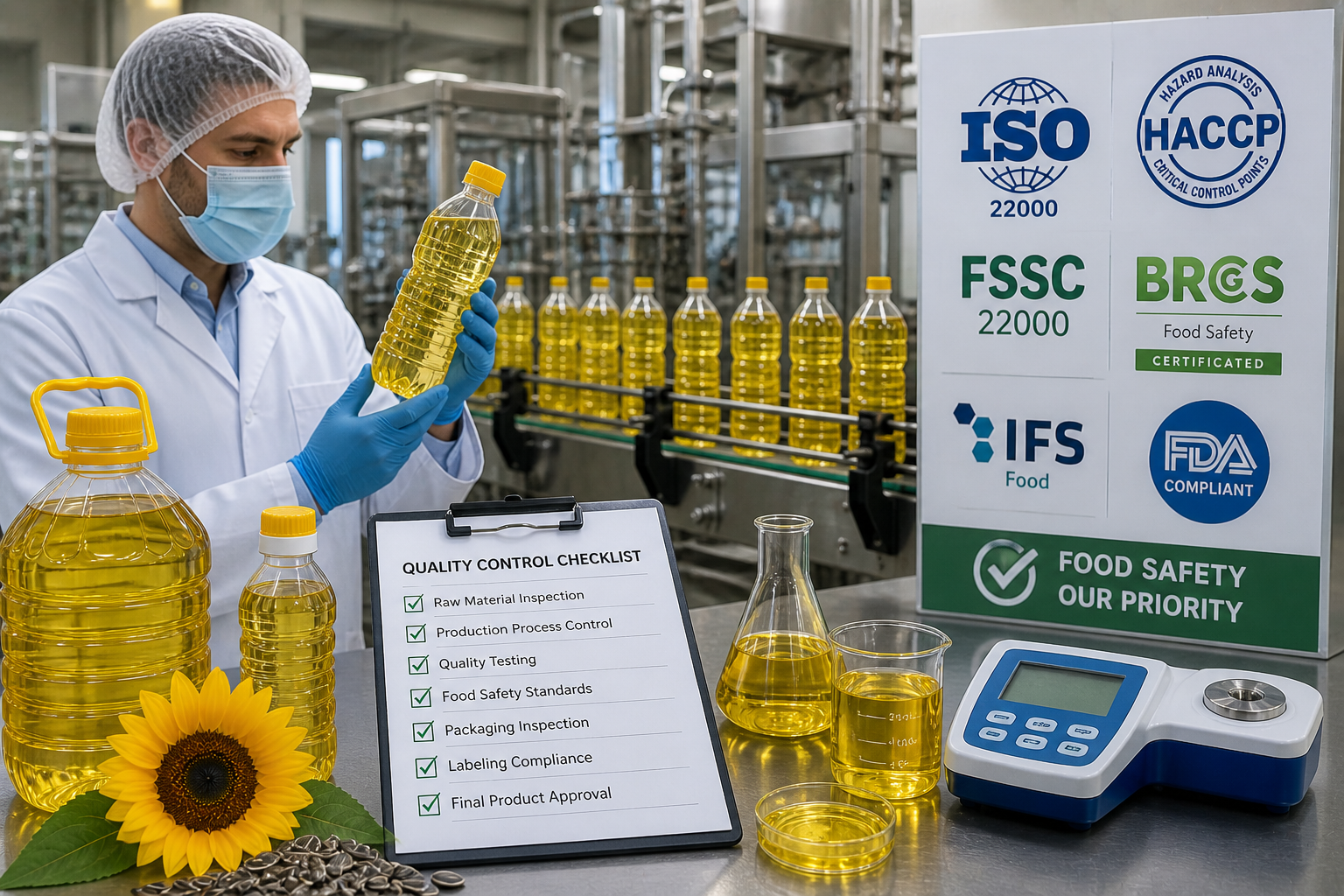
Food Safety Standards for Sunflower Oil Export
Food safety standards are a critical requirement in the international sunflower oil trade. For importers, distributors, food manufacturers, and private label brands, compliance with these standards ensures that sunflower oil is safe, traceable, and suitable for human consumption across global markets.
This guide explains the key food safety standards for sunflower oil export, including European Union requirements, international certifications, quality control systems, and how buyers can ensure compliance when working with a bulk sunflower oil supplier.
—Why Food Safety Standards Matter in Sunflower Oil Export
Sunflower oil is classified as a food product, which means it must meet strict hygiene, quality, and traceability requirements before it can enter international markets. These standards protect consumers, ensure product consistency, and maintain trust in global supply chains.
For exporters and buyers, compliance helps to:
- Ensure product safety and quality
- Meet import regulations
- Avoid shipment rejection or delays
- Build long-term buyer trust
- Support retail and private label distribution
European Union Food Safety Requirements
The European Union has some of the strictest food safety regulations in the world. Sunflower oil imported into EU countries must comply with regulations covering hygiene, traceability, labeling, and contamination control.
Key EU requirements include:
- Compliance with food hygiene standards
- Full traceability of product origin
- Proper labeling and documentation
- Testing for contaminants and residues
Official guidance is available through the European Commission Food Safety portal .
Importers planning shipments should also review how to import sunflower oil into Europe to understand the full compliance process.
—HACCP Certification in Sunflower Oil Export
HACCP (Hazard Analysis and Critical Control Points) is a globally recognized food safety management system. It identifies potential hazards in production and establishes controls to prevent contamination.
For sunflower oil exporters, HACCP ensures:
- Safe production processes
- Control of contamination risks
- Consistent quality standards
- Compliance with international food regulations
Most European buyers require HACCP certification before approving a supplier. Learn more through HACCP certification.
—ISO Standards for Sunflower Oil Export
ISO standards provide a framework for quality management and operational consistency. In sunflower oil export, ISO certification demonstrates that the supplier follows internationally recognized production and quality control processes.
Common ISO standards include:
- ISO 9001 – Quality management systems
- ISO 22000 – Food safety management systems
These certifications increase trust and help suppliers meet international buyer requirements. See ISO standards for sunflower oil.
—Halal Certification for Specific Markets
Halal certification is required when exporting sunflower oil to markets with specific dietary requirements, including parts of Europe, the Middle East, and Asia.
This certification confirms that the product meets Islamic dietary standards and is handled according to approved processes.
More details are available at Halal certification and Halal-certified sunflower oil.
—Traceability and Product Origin
Traceability is a key requirement in international food trade. Buyers must be able to track sunflower oil from production to delivery.
This includes:
- Origin of raw materials
- Processing location
- Batch identification
- Shipment tracking
Traceability ensures transparency and allows authorities to verify product safety at any stage of the supply chain.
—Quality Control in Export Supply Chains
Quality control ensures that sunflower oil meets required standards before shipment. This includes testing, inspection, and verification processes.
Key quality checks include:
- Purity and composition testing
- Contaminant screening
- Packaging integrity inspection
- Storage condition verification
Buyers can review full processes at quality control systems and certifications overview.
—Packaging and Food Safety Compliance
Packaging must meet food safety standards to prevent contamination during transport and storage. Food-grade materials and proper sealing are essential.
Common requirements include:
- Food-grade containers
- Proper sealing and labeling
- Protection from external contamination
- Compliance with import regulations
Explore more at packaging solutions and packaging types.
—Logistics and Handling Standards
Food safety extends beyond production to logistics and transport. Improper handling can compromise product quality even if production standards are met.
Important logistics considerations:
- Clean transport containers
- Temperature control where required
- Secure sealing during transit
- Proper unloading procedures
Learn more about international logistics and bulk shipping methods.
—Common Compliance Mistakes to Avoid
Importers and exporters should avoid these common mistakes:
- Incomplete documentation
- Lack of certification
- Incorrect labeling
- Poor traceability systems
- Using non-compliant packaging
Proper planning and supplier verification can prevent these issues. See exporter verification.
—Final Thoughts on Food Safety Standards
Food safety standards are essential for successful sunflower oil export. Compliance ensures smooth customs clearance, protects product quality, and builds trust with buyers.
For businesses importing sunflower oil into Europe or other regulated markets, working with certified and experienced suppliers is critical. You can request a quotation based on your product and compliance requirements.
—Frequently Asked Questions
What food safety standards apply to sunflower oil export?
Sunflower oil must comply with EU food safety regulations, HACCP systems, and ISO standards depending on the market.
Is HACCP required for sunflower oil export?
Yes, HACCP is widely required to ensure safe production and compliance with international standards.
Why is traceability important?
Traceability allows buyers and regulators to track the product from origin to delivery, ensuring safety and transparency.
Do all markets require Halal certification?
No, but it is required for specific regions and buyer segments.
How can buyers ensure compliance?
By working with certified suppliers, verifying documentation, and understanding import regulations.