
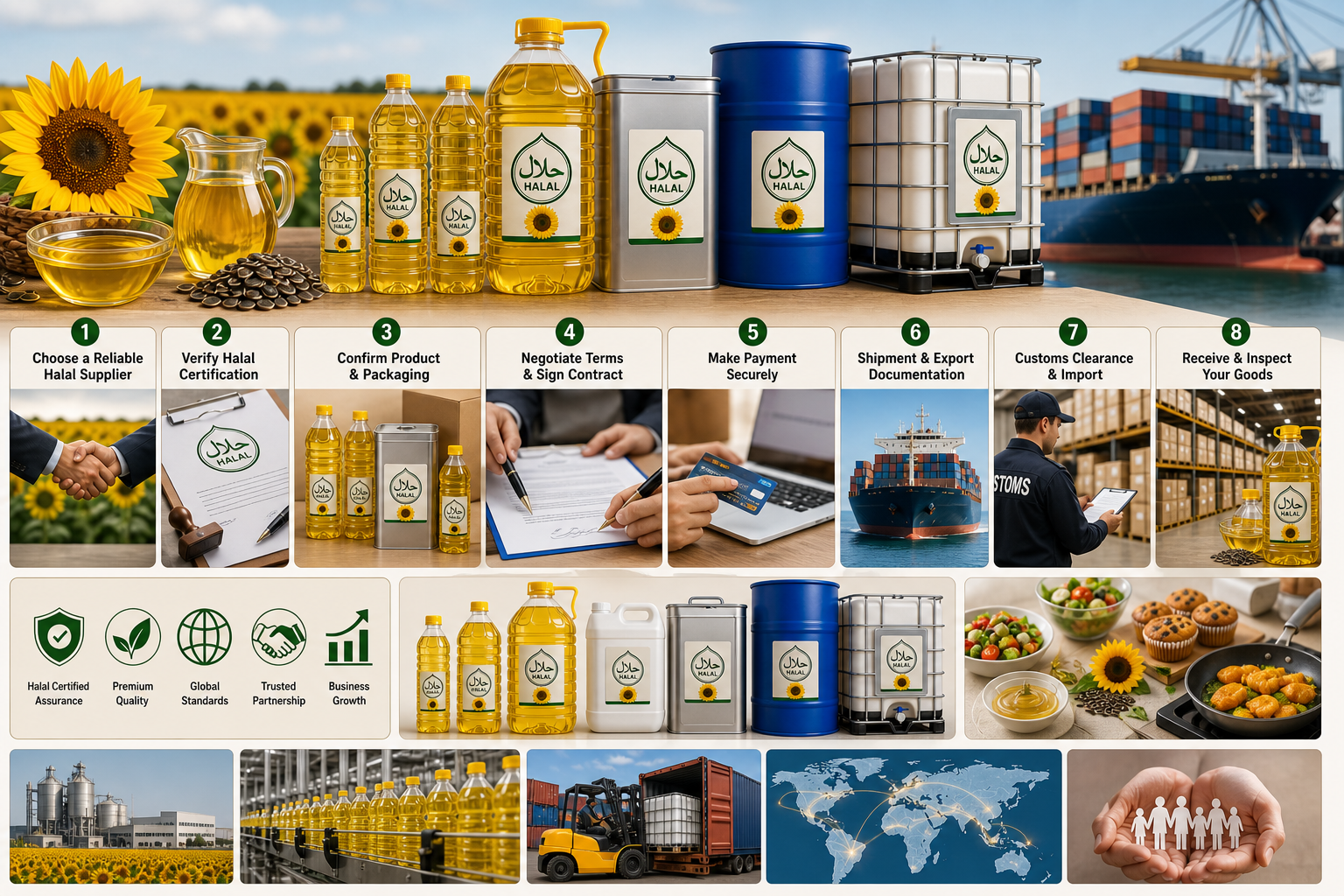
Halal Food Export Standards Explained
Halal food export standards are essential for companies involved in international food trade, especially when supplying products such as sunflower oil to markets that require halal compliance. Importers, distributors, and food manufacturers must ensure that products meet both halal certification requirements and international food safety standards.
This guide explains halal export standards, certification requirements, documentation, and compliance processes for businesses involved in global food supply chains.
—What Are Halal Food Export Standards?
Halal food export standards define the rules and procedures that ensure food products are produced, processed, handled, and transported according to halal principles. These standards apply across the entire supply chain, including raw material sourcing, manufacturing, packaging, storage, and logistics.
For sunflower oil exporters, compliance ensures that products such as halal certified sunflower oil can be legally and commercially distributed in halal-regulated markets.
—Why Halal Certification Is Important in Food Export
Halal certification is required for exporting food products to many regions, including the Middle East, Southeast Asia, and parts of Africa. It also plays a key role in building trust with international buyers and distributors.
- Ensures compliance with religious and regulatory requirements
- Expands access to global halal markets
- Increases product acceptance among retailers and distributors
- Supports private label and branded food products
In addition to halal certification, exporters must also comply with food safety regulations. Organizations such as FAO provide global guidance on food safety and agricultural trade.
—Key Components of Halal Food Export Compliance
To successfully export halal food products, companies must meet several compliance requirements:
- Valid halal certification from a recognized authority
- Traceability of ingredients and production processes
- Separation from non-halal materials during production and storage
- Clean and controlled packaging and transportation systems
- Accurate labeling and documentation
Exporters should also review certification requirements including ISO and HACCP to ensure full compliance.
—Halal Certification for Sunflower Oil Export
Sunflower oil is naturally plant-based, but certification ensures that the entire production process complies with halal standards. This includes refining, storage, packaging, and handling.
Exporters supplying products such as refined sunflower oil or bottled sunflower oil must ensure that no contamination occurs during processing or transportation.
—Export Documentation for Halal Food Products
Proper documentation is critical when exporting halal food products. Typical export documents include:
- Commercial invoice
- Packing list
- Bill of lading
- Certificate of origin
- Halal certificate
- Quality and inspection certificates
For more detailed information, visit export compliance and export documentation requirements.
—Packaging and Handling Requirements
Packaging plays an important role in maintaining halal compliance. Exporters must ensure that packaging materials are clean, suitable for food use, and free from contamination risks.
Common packaging formats include:
- Retail bottles (1L, 2L, 5L)
- Bulk containers for industrial buyers
- Palletized shipments for distributors
Explore packaging solutions and packaging types for detailed options.
—Logistics and Transportation Standards
Halal food products must be transported in conditions that prevent contamination. This includes proper cleaning of containers, separation from non-halal goods, and secure handling during transit.
Shipping methods may include:
- Container shipping for international export
- Road freight within Europe
- Bulk transport using flexitanks or ISO tanks
Learn more about shipping methods and export logistics.
For official trade terminology, refer to ICC Incoterms.
—Challenges in Halal Food Export
Exporters and importers may face several challenges when dealing with halal food standards:
- Differences in certification requirements between countries
- Verification of supplier credentials
- Documentation errors or inconsistencies
- Logistics and storage compliance
Working with experienced exporters helps reduce these risks and ensures smooth international trade operations.
—Why Work with a Certified Export Supplier
Experienced exporters such as Inter Oliya support buyers with halal-certified supply, documentation, packaging, and logistics coordination. This simplifies the process for importers and ensures compliance with international standards.
For supply inquiries, you can request a quotation based on your requirements.
—Conclusion
Halal food export standards are essential for businesses involved in international food trade. By understanding certification requirements, documentation, packaging, and logistics, exporters and importers can ensure compliance and build reliable supply chains.
For sunflower oil exporters and buyers, meeting halal standards is not only a requirement but also a competitive advantage in global markets.
—Frequently Asked Questions
What is halal food certification?
Halal certification verifies that a product complies with halal standards throughout its production and supply chain.
Is sunflower oil halal?
Sunflower oil is plant-based but requires certification to confirm halal compliance in commercial trade.
What documents are required for halal food export?
Documents include halal certificate, invoice, packing list, bill of lading, and certificate of origin.
Why is halal certification important for exporters?
It ensures compliance with regulations and allows access to halal markets worldwide.
—