
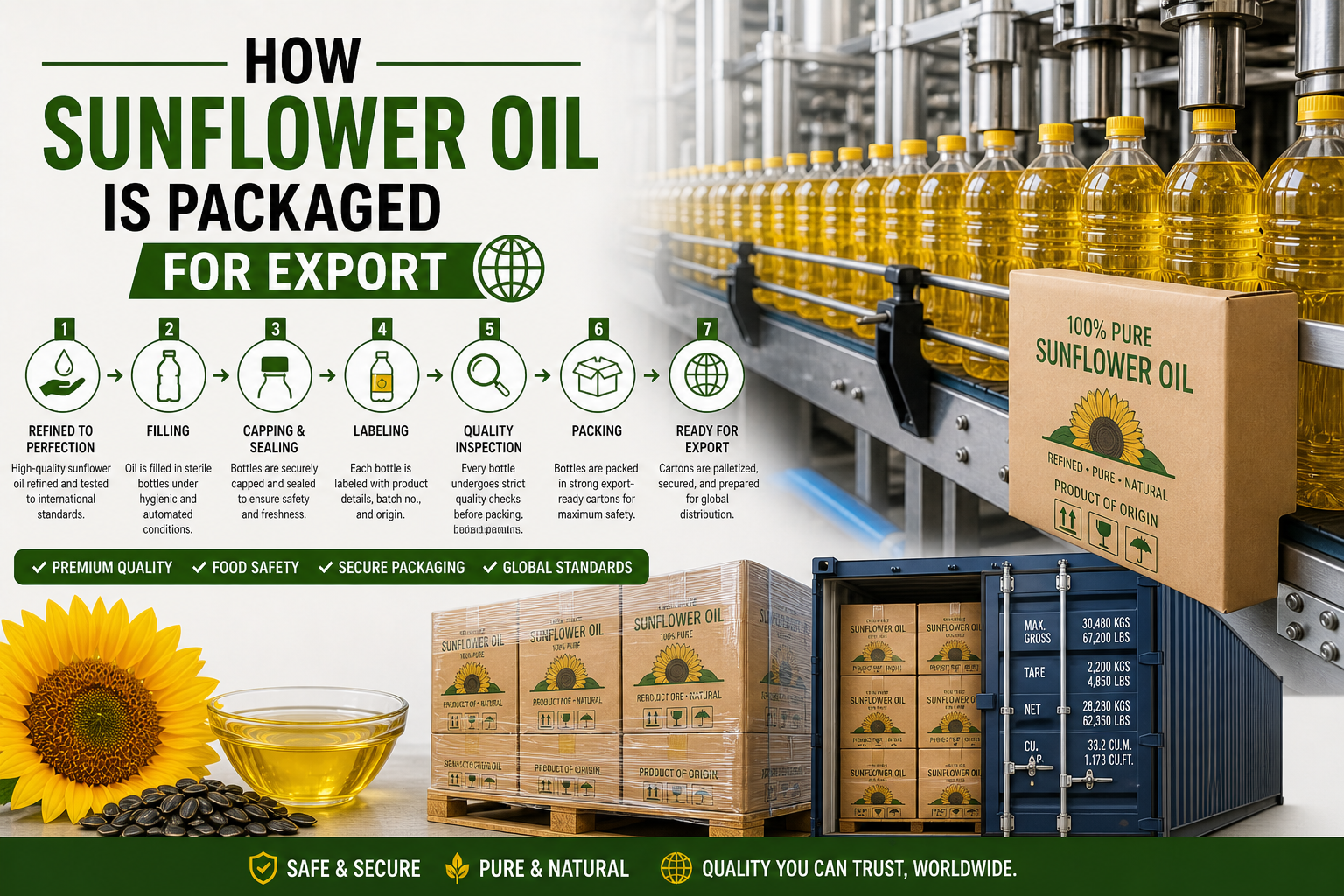
How Sunflower Oil Is Packaged for Export
Sunflower oil packaging for export is a critical stage in the supply chain that ensures the product remains stable, safe, and commercially viable during transportation and storage. Proper packaging protects the oil from contamination, leakage, oxidation, and physical damage, especially when shipments are transported over long distances.
For importers, distributors, supermarkets, and private label brands, packaging is not just a logistical requirement. It directly affects product quality, shelf life, handling efficiency, and overall market presentation.
At Inter Oliya’s packaging solutions, packaging systems are designed to meet both bulk and retail export requirements, supporting international buyers with reliable and scalable supply options.
Why Packaging Is Important in Sunflower Oil Export
Sunflower oil is a sensitive product that can degrade if exposed to air, light, moisture, or contamination. Without proper packaging, oil quality may decline during transport or storage.
Export packaging ensures that:
- The oil remains stable during long-distance transportation
- Product quality is preserved under varying environmental conditions
- Leakage and contamination risks are minimized
- Handling and logistics operations are efficient
- Retail products maintain their visual appeal
For global food trade, packaging must also align with international standards. Organizations such as the Food and Agriculture Organization (FAO) emphasize the importance of proper food handling and packaging systems in global supply chains.
Main Packaging Types for Sunflower Oil Export
Sunflower oil can be packaged in different formats depending on the buyer type, order size, and intended use. Export packaging generally falls into two main categories: bulk packaging and retail packaging.
1. Bulk Packaging for Industrial Buyers
Bulk packaging is used for large-scale shipments to refineries, food manufacturers, and wholesale distributors. It is designed for efficiency, cost optimization, and large volume handling.
- Flexitanks: Flexible containers placed inside standard shipping containers, typically used for liquid bulk transport.
- ISO Tanks: Specialized tank containers designed for transporting liquids in large quantities.
- IBC Tanks: Intermediate bulk containers used for medium-scale transport and storage.
- Drums: Steel or plastic drums used for smaller bulk shipments.
Bulk packaging is commonly used for bulk sunflower oil supply and industrial applications.
2. Bottled Packaging for Retail and Private Label
Bottled packaging is used for supermarket distribution, foodservice, and private label brands. These formats are designed for direct consumer use.
- 1L, 2L, and 5L bottles for retail markets
- 10L and 20L containers for foodservice and commercial kitchens
- Carton-packed units for distribution
Retail packaging must meet strict requirements for labeling, sealing, and durability. Businesses can explore private label sunflower oil for customized packaging and branding solutions.
Packaging Materials Used for Sunflower Oil
The choice of packaging material is important for maintaining oil quality and ensuring safe transport.
- PET Plastic Bottles: Lightweight, cost-effective, and commonly used for retail packaging
- HDPE Containers: Stronger plastic containers used for larger volumes
- Metal Drums: Durable and suitable for bulk transport
- Flexitank Liners: Specialized materials designed for liquid bulk shipping
These materials are selected based on durability, compatibility with edible oil, and ability to protect the product during transit.
Packaging Process in Export Operations
The packaging process is typically carried out in automated or semi-automated systems within manufacturing facilities.
1. Filling
Refined sunflower oil is transferred into containers using controlled filling systems to ensure accurate volume and minimal contamination.
2. Sealing
Containers are sealed to prevent leakage and exposure to air. Proper sealing is essential for maintaining product integrity.
3. Labeling
Labels are applied according to buyer requirements, including product details, origin, batch numbers, and compliance information.
4. Carton Packing
Bottled products are packed into cartons for protection and easier handling during transport.
5. Palletization
Cartons are arranged on pallets to improve storage efficiency and facilitate loading and unloading operations.
This structured packaging process supports both efficiency and quality control across the supply chain.
Packaging and Storage Considerations
Proper storage conditions are essential after packaging. Sunflower oil should be stored in clean, dry environments away from direct sunlight and extreme temperatures.
Temperature control and handling practices play a key role in maintaining product stability. Buyers can review storage and logistics to understand how packaged oil is managed before shipment.
Export Logistics and Packaging Coordination
Packaging must be coordinated with logistics to ensure smooth export operations. This includes selecting appropriate container types, securing shipments, and preparing documentation.
Different packaging formats may require different shipping methods. Buyers can explore sunflower oil shipping methods and export logistics to understand how packaging integrates with transport.
For international trade, delivery terms such as FOB, CIF, DAP, and DDP define responsibilities between buyers and suppliers. The ICC Incoterms rules provide guidance on these terms.
Packaging and Quality Assurance
Packaging is closely linked to quality assurance. Even high-quality oil can be compromised if packaging is inadequate.
Quality checks during packaging include:
- Container integrity inspection
- Seal verification
- Label accuracy checks
- Leak testing
These checks are part of a broader quality control system that ensures the product reaches buyers in optimal condition.
Why Packaging Matters for Private Label Brands
For private label sunflower oil, packaging plays a key role in branding and market positioning. Packaging must be visually appealing, durable, and compliant with retail standards.
Consumers often judge product quality based on packaging appearance. This makes packaging design and consistency critical for brand success.
Conclusion
Sunflower oil packaging for export is a complex process that combines product protection, logistics efficiency, and commercial presentation. Whether for bulk shipments or retail distribution, proper packaging ensures that oil maintains its quality from production to final use.
For buyers, understanding packaging options helps improve procurement decisions and ensures that the product meets their specific requirements.
If you are sourcing sunflower oil for export, wholesale, or private label distribution, you can explore refined sunflower oil supply or submit an inquiry through the request quote page.
Frequently Asked Questions
What is the best packaging for sunflower oil export?
The best packaging depends on the order size and application. Flexitanks and ISO tanks are used for bulk shipments, while bottles and cartons are used for retail products.
Why is packaging important for sunflower oil?
Packaging protects the oil from contamination, oxidation, and damage during transport and storage.
What packaging materials are used for sunflower oil?
Common materials include PET plastic, HDPE containers, metal drums, and flexitank liners.
Can sunflower oil be exported in bulk?
Yes, sunflower oil is commonly exported in bulk using flexitanks, ISO tanks, and drums.
Is packaging important for private label sunflower oil?
Yes, packaging is critical for branding, product protection, and consumer perception in retail markets.