
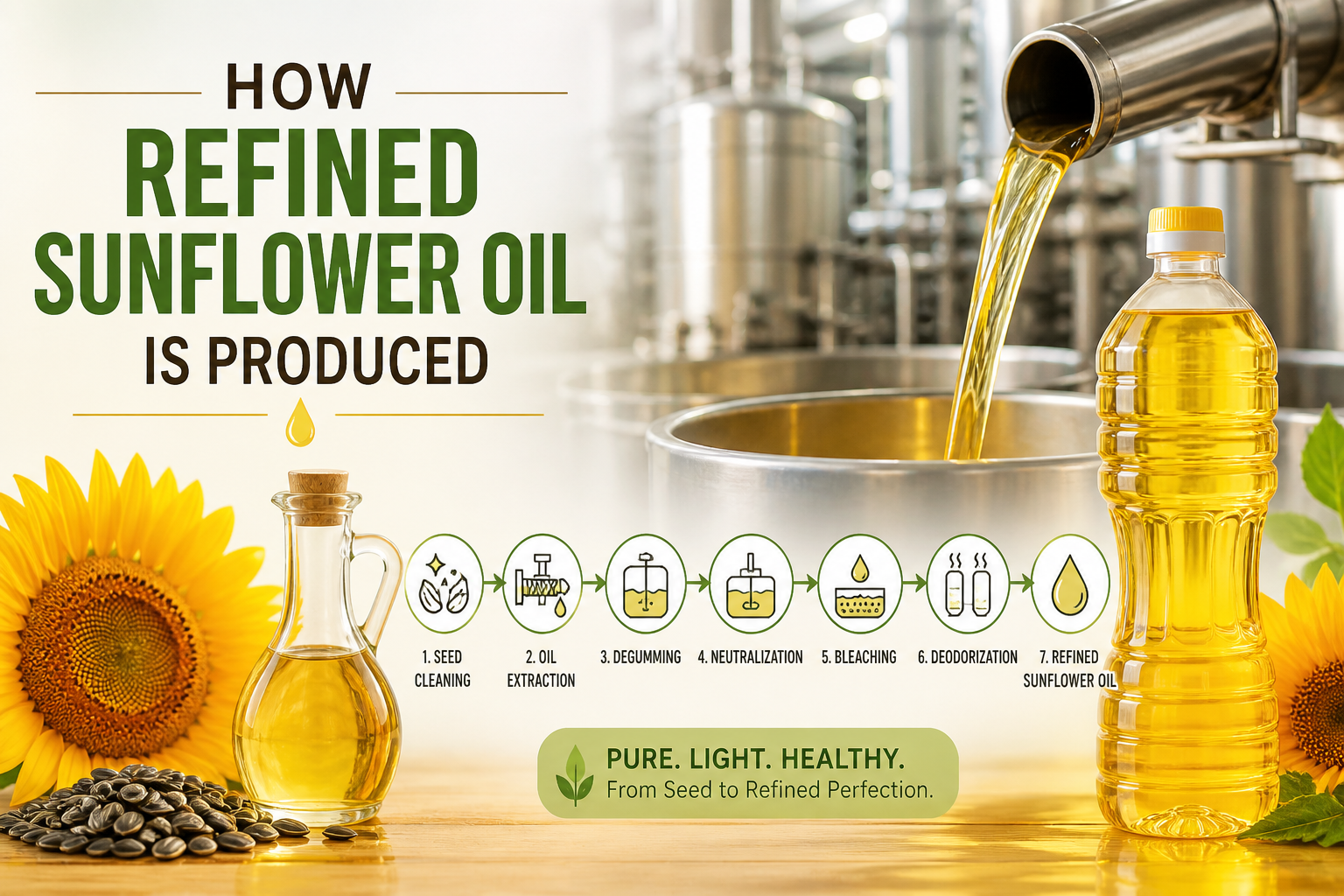
How Refined Sunflower Oil Is Produced
Refined sunflower oil is produced through a multi-stage industrial process that transforms crude sunflower oil into a clean, stable, and food-grade edible oil suitable for cooking, retail packaging, food manufacturing, and international export. This process involves removing impurities such as phospholipids, free fatty acids, waxes, pigments, and odor compounds while preserving the oil’s usability and performance.
For importers, distributors, food manufacturers, and private label brands, understanding how refined sunflower oil is produced is essential. The production process directly affects oil quality, shelf life, packaging compatibility, and overall commercial value.
Companies sourcing oil for bulk supply or retail distribution typically rely on structured refining systems such as those used in industrial sunflower oil refining operations. These systems ensure the oil meets consistent quality expectations for global markets.
Step 1: Sunflower Seed Processing and Oil Extraction
The production of refined sunflower oil begins with sunflower seeds. The seeds are cleaned to remove dust, stones, and foreign materials before being dehulled and crushed. This prepares the seeds for oil extraction.
Oil extraction is usually carried out using mechanical pressing or solvent extraction. The result is crude sunflower oil, which still contains natural impurities. At this stage, the oil is not yet suitable for most food applications.
Crude oil is typically supplied to refineries or further processed depending on the supply chain. Businesses sourcing crude sunflower oil usually intend to refine or process it further before commercial use.
Step 2: Degumming
Degumming is the first refining step and focuses on removing phospholipids and gums from crude sunflower oil. These compounds can cause instability, poor appearance, and processing issues.
During degumming, water or acid treatment is used to hydrate the gums, making them easier to separate from the oil through centrifugation. This improves the oil’s clarity and prepares it for further refining.
Step 3: Neutralization
Neutralization removes free fatty acids that affect taste, odor, and shelf life. These acids are reacted with an alkaline solution to form soapstock, which is then separated from the oil.
This step is essential for improving oil stability and making it suitable for commercial food applications. Without neutralization, sunflower oil may deteriorate more quickly during storage and use.
For buyers comparing refined vs crude sunflower oil, neutralization is one of the key differences between raw and finished edible oil.
Step 4: Washing and Drying
After neutralization, the oil is washed to remove residual soap and impurities. It is then dried to reduce moisture content.
Moisture control is critical because excess water can affect shelf life and stability. Proper drying ensures the oil is ready for bleaching and further purification.
Step 5: Bleaching
Bleaching improves the visual quality of sunflower oil by removing pigments such as chlorophyll and carotenoids. This is achieved using bleaching earth or activated carbon.
The process also helps remove trace metals and oxidation compounds that can impact oil stability. The result is a lighter-colored oil suitable for retail and food production.
Clean appearance is particularly important for bottled oil products and private label brands, where visual quality directly affects consumer perception.
Step 6: Winterization and Dewaxing
Sunflower oil naturally contains waxes that can cause cloudiness when stored at lower temperatures. Winterization or dewaxing removes these waxes by cooling the oil and filtering out crystallized particles.
This step ensures the oil remains clear during storage, transport, and shelf display. It is especially important for bottled sunflower oil and export-ready products.
Buyers working with retail-ready packaging can explore sunflower oil packaging solutions to understand how refined oil is prepared for commercial distribution.
Step 7: Deodorization
Deodorization removes unwanted odors and flavors from sunflower oil. This is done using steam distillation under high temperature and vacuum conditions.
The process results in a neutral-tasting oil that is widely used in cooking, frying, and food manufacturing. A neutral profile is essential because it allows the oil to be used across various food applications without affecting flavor.
According to international food safety systems such as ISO 22000 standards, proper processing and control systems are essential in food production and supply chains.
Step 8: Final Filtration and Polishing
After deodorization, the oil undergoes final filtration to remove any remaining particles. This polishing step ensures maximum clarity and quality before packaging or bulk loading.
At this stage, the oil is considered fully refined and ready for commercial use.
Step 9: Quality Control and Testing
Before refined sunflower oil is packaged or exported, it goes through quality control checks. These may include testing for color, odor, acidity, moisture content, and overall purity.
A structured quality control process ensures consistency and reduces risks for buyers importing or distributing the oil.
Step 10: Packaging and Export Preparation
Once refined, sunflower oil is prepared for packaging or bulk shipment. Packaging formats may include bottles, drums, IBC tanks, or flexitanks depending on buyer requirements.
Export-ready oil must be handled carefully to maintain quality during transport. Buyers can review sunflower oil shipping methods and delivery terms to understand how oil is transported internationally.
For private label or retail-ready products, refined oil is typically filled into bottles and cartons. Businesses planning custom branding can explore private label sunflower oil solutions.
Why Refined Sunflower Oil Is Preferred for Commercial Use
- Neutral taste and odor: suitable for a wide range of food applications
- Clear appearance: important for retail packaging
- Improved shelf life: better stability during storage
- Versatility: used in cooking, frying, and food manufacturing
- Export readiness: suitable for international trade and distribution
For this reason, refined sunflower oil is widely used by supermarkets, food manufacturers, restaurants, and distributors worldwide.
Refined Sunflower Oil in Global Trade
Refined sunflower oil plays a major role in international food supply chains. Buyers sourcing oil from major producing regions often prioritize consistency, documentation, and reliable logistics.
Understanding global trade practices is important for importers. The Incoterms rules by the International Chamber of Commerce define responsibilities between buyers and sellers in international shipments.
Companies sourcing bulk sunflower oil supply or refined oil for distribution should ensure the supplier can support packaging, documentation, and export requirements.
Conclusion
The production of refined sunflower oil is a structured process that transforms crude oil into a clean, stable, and commercially usable product. Each stage—from extraction to refining, quality control, and packaging—plays a critical role in ensuring the final oil meets international standards.
For buyers, understanding how refined sunflower oil is produced helps improve sourcing decisions, reduce risks, and ensure the product meets the needs of retail, food manufacturing, or export markets.
If you are sourcing refined sunflower oil for wholesale, private label, or international distribution, you can explore refined sunflower oil supply or submit an inquiry through the request quote page.
Frequently Asked Questions
How is refined sunflower oil produced?
Refined sunflower oil is produced by extracting crude oil from sunflower seeds and then processing it through stages such as degumming, neutralization, bleaching, dewaxing, deodorization, and filtration.
What is the difference between crude and refined sunflower oil?
Crude sunflower oil contains natural impurities and is usually used for further processing, while refined sunflower oil has been treated to improve clarity, taste, stability, and usability for food applications.
Why is deodorization important in oil production?
Deodorization removes unwanted odors and flavors, resulting in a neutral oil that is suitable for cooking and food manufacturing.
Is refined sunflower oil suitable for export?
Yes, refined sunflower oil is commonly exported worldwide because of its stability, packaging compatibility, and compliance with food standards.
Can refined sunflower oil be used for private label brands?
Yes, refined sunflower oil is widely used in private label products because it offers consistent quality, clean appearance, and neutral taste.