
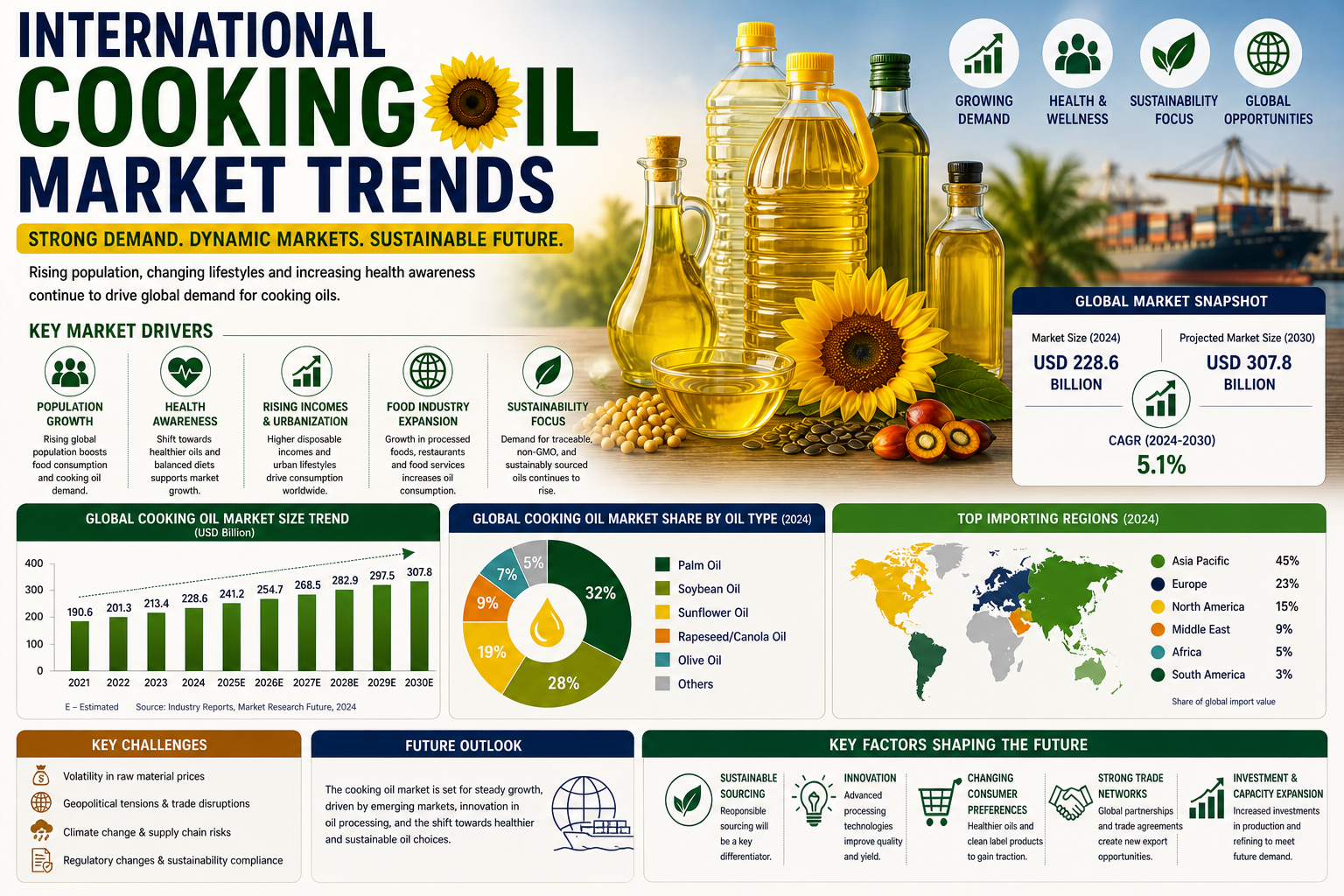
International Cooking Oil Market Trends for Global Buyers
International cooking oil market trends are important for importers, wholesalers, distributors, supermarkets, food manufacturers, and private label brands. The global cooking oil market is influenced by consumer demand, agricultural production, vegetable oil prices, logistics costs, packaging requirements, and food industry growth.
Sunflower oil remains one of the most important cooking oils in global trade because it is widely used for frying, cooking, baking, food manufacturing, bottled retail products, and private label brands. Inter Oliya supports international buyers with sunflower oil supply, packaging solutions, and export coordination.
Why the International Cooking Oil Market Matters
Cooking oils are essential products in household consumption, restaurants, foodservice, supermarkets, and industrial food manufacturing. Because edible oils are used daily across global markets, changes in supply, pricing, and logistics can directly affect buyers and distributors.
The FAO Vegetable Oil Price Index increased by 5.1% in March 2026 and remained 13.2% above its level one year earlier, driven by higher quotations across palm, soy, sunflower, and rapeseed oils. FAO Food Price Index.
Buyers interested in sunflower oil procurement can review our bulk sunflower oil supplier page.
Key International Cooking Oil Market Trends
1. Rising Demand for Vegetable Oils
Global demand for vegetable oils continues to grow due to population growth, urbanization, food manufacturing expansion, and increased consumption of packaged foods. Sunflower oil, palm oil, soybean oil, rapeseed oil, and olive oil all play important roles in international food supply.
Buyers can compare sunflower oil supply options on our sunflower oil products page.
2. Strong Demand for Sunflower Oil
Sunflower oil demand remains strong because of its neutral taste, wide cooking use, and suitability for food production. It is used by households, food manufacturers, bakeries, snack producers, restaurants, wholesalers, and retail brands.
For finished food-grade supply, buyers can explore our refined sunflower oil page and our article on food grade sunflower oil.
3. Vegetable Oil Price Volatility
Cooking oil prices remain sensitive to crop production, export availability, freight costs, energy markets, and global demand. USDA reported that sunflower oil export prices continued to climb from September 2025 to March 2026, supported by strong global demand and supply conditions. USDA Oilseeds: World Markets and Trade.
Buyers can read our sunflower oil price forecast for more market insight.
4. Growth of Private Label Cooking Oil
Private label cooking oil is growing as supermarkets, distributors, and retail brands develop their own packaged oil products. This increases demand for custom labels, bottle sizes, carton packaging, pallet loading, and export-ready retail supply.
Businesses planning retail supply can review our private label sunflower oil, bottled sunflower oil, and packaging solutions pages.
5. Logistics and Supply Chain Pressure
International cooking oil trade depends heavily on logistics. Freight costs, container availability, port access, road delivery, fuel prices, and delivery terms can all affect final buyer pricing and delivery timelines.
Buyers can review our export logistics, shipping methods, and delivery terms pages.
Major Cooking Oils in Global Trade
Sunflower Oil
Sunflower oil is widely used in Europe and international markets for cooking, frying, and food manufacturing. It is also important for bottled retail products and private label brands.
Palm Oil
Palm oil remains one of the largest vegetable oils in global trade due to its use in food manufacturing, processed foods, and industrial applications.
Soybean Oil
Soybean oil demand is influenced by food use and biofuel demand. Changes in soybean crushing and biofuel policies can affect global vegetable oil pricing.
Rapeseed Oil
Rapeseed oil is widely used in Europe and is influenced by regional crop production, import demand, and biodiesel-related usage.
How Global Cooking Oil Trends Affect Buyers
Cooking oil buyers must evaluate both product cost and supply reliability. A lower price is not always the best option if the supplier cannot provide quality, documentation, packaging consistency, and export support.
- Importers need stable supply and clear delivery terms.
- Wholesalers need reliable bulk procurement.
- Food manufacturers need consistent quality and regular availability.
- Supermarkets need retail-ready packaging and private label options.
- Distributors need flexible packaging and logistics support.
Buyers can also read our guide to choosing a reliable sunflower oil supplier.
Regional Demand Trends
Europe
Europe remains a major edible oil market due to food manufacturing, retail demand, and private label growth. Buyers can review our European edible oil industry trends article.
Relevant country pages include Germany, France, Netherlands, Belgium, Spain, Italy, and Poland.
Africa and Middle East
Africa and the Middle East continue to show strong demand for imported cooking oils due to population growth, urbanization, and foodservice expansion.
Global Food Manufacturing Markets
Food manufacturers worldwide rely on cooking oils for processed foods, snacks, sauces, bakery products, and prepared meals. This creates long-term demand for bulk refined sunflower oil.
Buyer Strategy for the International Cooking Oil Market
Confirm Product Type and Use
Buyers should confirm whether they need refined oil, crude oil, bottled oil, organic sunflower oil, high oleic sunflower oil, halal-certified sunflower oil, or private label products.
Understand Packaging Requirements
Packaging affects price, logistics, shelf presentation, and buyer suitability. Relevant options include bottles, cartons, drums, IBC tanks, flexitanks, and palletized products.
Learn more through our packaging types page.
Review Delivery Terms
Delivery terms such as FOB, CIF, DAP, and DDP affect the final landed cost. The International Chamber of Commerce Incoterms rules explain responsibilities between buyers and sellers in global trade.
Buyers can also read our CIF, FOB, and DAP shipping terms guide.
Conclusion
International cooking oil market trends show strong demand, price sensitivity, logistics pressure, and growth in private label retail products. For buyers, successful sourcing depends on reliable suppliers, clear specifications, proper documentation, and efficient export coordination.
Inter Oliya supports importers, wholesalers, food manufacturers, distributors, supermarkets, and private label brands with sunflower oil supply for global markets. To begin sourcing, visit our request quote page or explore our sunflower oil product range.
Frequently Asked Questions
What are the main international cooking oil market trends?
Main trends include rising vegetable oil demand, sunflower oil price volatility, private label growth, logistics pressure, and stronger buyer focus on reliable supply.
Why is sunflower oil important in the cooking oil market?
Sunflower oil is widely used for cooking, frying, food manufacturing, bottled retail products, and private label brands.
What affects cooking oil prices globally?
Cooking oil prices are affected by crop output, export availability, energy prices, freight costs, global demand, and supply chain conditions.
Is private label cooking oil demand growing?
Yes. Supermarkets, distributors, and retail brands are increasingly developing private label cooking oil products with custom packaging.
Where can buyers request sunflower oil supply?
Buyers can submit product, quantity, packaging, and destination details through the Inter Oliya request quote page.