
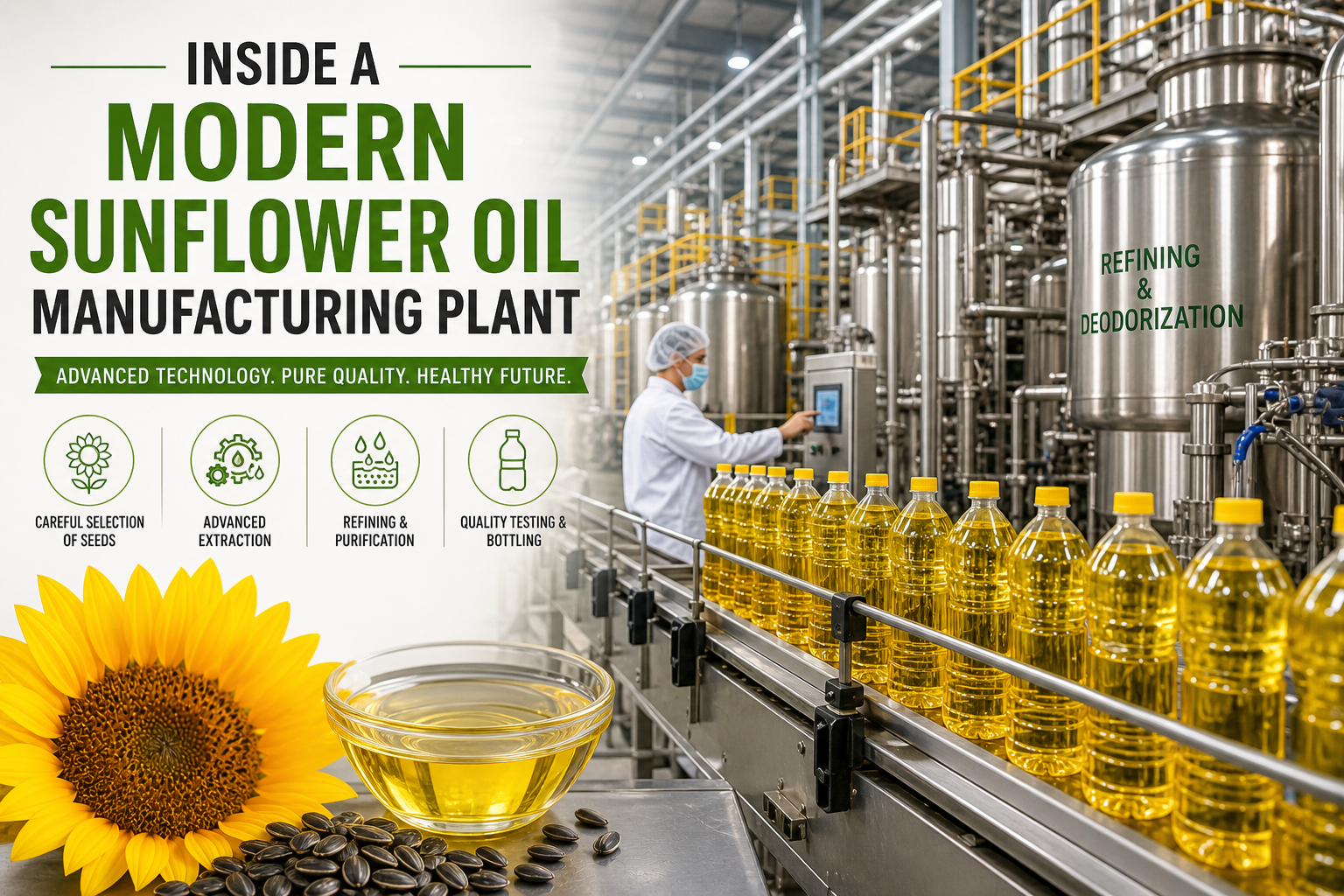
Inside a Modern Sunflower Oil Manufacturing Plant
A modern sunflower oil manufacturing plant is a highly organized industrial facility designed to process sunflower seeds into crude and refined sunflower oil at scale. These facilities combine mechanical systems, chemical processing, quality control laboratories, storage infrastructure, and export logistics to produce oil that meets international food and trade standards.
For importers, distributors, and food manufacturers, understanding how a sunflower oil plant operates provides insight into production capacity, product consistency, quality assurance, and supply reliability. This is especially important when sourcing from industrial suppliers or planning long-term procurement.
At Inter Oliya’s manufacturing operations, the process is structured to support bulk production, private label packaging, and export-ready supply for international markets.
Raw Material Handling and Seed Preparation
The process begins with the arrival of sunflower seeds at the facility. These seeds are cleaned using industrial equipment to remove dust, stones, and foreign materials. Proper cleaning is essential to protect processing machinery and ensure consistent oil quality.
After cleaning, the seeds are dehulled and prepared for oil extraction. This step improves efficiency and helps maximize oil yield during processing.
Seed quality plays a critical role in final product quality. High-quality raw materials result in better oil clarity, stability, and overall performance.
Oil Extraction Section
The extraction section is where oil is separated from sunflower seeds. This is typically done using mechanical pressing or solvent extraction, depending on the facility design and production scale.
The output at this stage is crude sunflower oil, which still contains natural impurities and requires further refining before it can be used in food applications.
Industrial buyers sourcing crude sunflower oil may use it for further refining, blending, or industrial processing.
Refining Department
The refining department is one of the most critical areas of the plant. Here, crude oil is processed into refined sunflower oil through several stages, including degumming, neutralization, bleaching, dewaxing, and deodorization.
Each stage is carefully controlled to remove impurities while preserving oil quality. This ensures the final product is suitable for cooking, food manufacturing, and retail packaging.
To understand the full technical breakdown, you can review the sunflower oil refining process in detail.
Quality Control Laboratory
A modern sunflower oil plant includes a dedicated quality control laboratory. This is where samples are tested throughout the production process to ensure consistency and compliance with required standards.
Quality checks may include:
- Color and clarity analysis
- Free fatty acid levels
- Moisture content
- Peroxide value
- Impurity levels
These tests help ensure that the oil meets both internal quality standards and buyer requirements. A strong quality control system reduces risks for importers and distributors.
International food safety frameworks such as ISO 22000 provide guidelines for managing food safety across production and supply chains.
Storage and Tank Systems
After refining, sunflower oil is stored in large industrial tanks designed to maintain product stability. These tanks are typically made of stainless steel and are equipped with temperature control systems to preserve oil quality.
Proper storage prevents contamination, oxidation, and degradation. This is especially important for export operations where oil may be stored before shipment.
Buyers can explore sunflower oil storage and logistics to understand how refined oil is handled before distribution.
Packaging and Bottling Section
In facilities that support retail or private label production, refined sunflower oil is transferred to packaging lines. These automated systems fill, cap, label, and pack bottles at high speed.
Common packaging formats include:
- 1L, 2L, 5L bottles
- 10L and 20L containers
- Carton-packed retail units
- Bulk packaging for distributors
Packaging quality is critical for product protection, shelf presentation, and brand positioning. Businesses planning custom branding can review private label sunflower oil solutions for retail-ready supply.
Bulk Loading and Export Operations
Modern sunflower oil plants are designed to support large-scale export operations. Bulk oil can be loaded into:
- Flexitanks
- ISO tanks
- IBC containers
- Drums and pallets
Export operations include documentation preparation, shipment coordination, and compliance with international trade standards.
Buyers sourcing oil internationally can review export logistics and shipping methods to understand how sunflower oil is transported globally.
For trade terms, the ICC Incoterms rules define responsibilities between buyers and suppliers in international transactions.
Automation and Production Efficiency
Modern sunflower oil plants rely heavily on automation to improve efficiency, reduce human error, and maintain consistent product quality. Control systems monitor temperature, pressure, flow rates, and processing conditions in real time.
This level of control allows manufacturers to produce large volumes of oil while maintaining uniform quality across batches.
Environmental and Safety Considerations
Industrial oil production facilities also focus on environmental management and safety systems. This may include waste management, energy efficiency measures, and compliance with environmental regulations.
Food safety and production standards are guided by international organizations such as the Food and Agriculture Organization (FAO), which provides global insights into food production and agricultural systems.
Why Manufacturing Capacity Matters for Buyers
For buyers, the structure of a sunflower oil manufacturing plant directly impacts supply reliability. Facilities with strong production systems can handle large orders, maintain consistent quality, and support long-term partnerships.
This is particularly important for:
- Wholesale distributors
- Food manufacturers
- Supermarket chains
- Private label brands
- Import/export companies
Buyers sourcing bulk sunflower oil or refined oil need suppliers with reliable production infrastructure and export capabilities.
Conclusion
A modern sunflower oil manufacturing plant is a complex system that integrates raw material processing, oil extraction, refining, quality control, storage, packaging, and export logistics. Each stage plays a role in ensuring the final product meets international standards and buyer expectations.
Understanding how these facilities operate helps buyers make informed sourcing decisions and evaluate supplier capabilities.
If your business requires reliable sunflower oil supply for wholesale, manufacturing, or retail distribution, you can explore refined sunflower oil or submit an inquiry through the request quote page.
Frequently Asked Questions
What happens inside a sunflower oil manufacturing plant?
A sunflower oil plant processes seeds into oil through cleaning, extraction, refining, quality control, and packaging or bulk export operations.
What equipment is used in sunflower oil production?
Equipment includes seed cleaners, crushers, oil presses, extraction systems, refining units, storage tanks, and packaging lines.
Is sunflower oil production fully automated?
Modern plants use automated systems to control processing conditions and improve efficiency, but human supervision is still required.
How is quality maintained in oil manufacturing plants?
Quality is maintained through laboratory testing, process monitoring, and adherence to food safety standards.
Can manufacturing plants support private label production?
Yes, many facilities include bottling and packaging lines for private label sunflower oil production.